







The Beginner's Trap: Relying on Arms
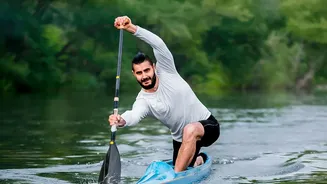
Watch any beginner in a kayak, and you will likely see the same thing: churning arms. They muscle the paddle through the water, relying on their biceps and shoulders to propel the boat. The result is rapid fatigue, a wobbly boat, and surprisingly little
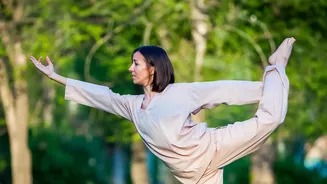
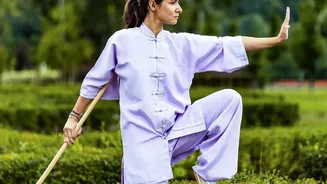
speed. Similarly, a novice learning a Tai Chi form often focuses on the hand and arm movements. Their motions can look disjointed and mechanical, lacking the art's signature graceful flow. In both activities, this focus on the extremities is a fundamental mistake. It’s an intuitive but inefficient approach that creates a hard ceiling on progress. Relying on the small muscles of the arms leads to quick exhaustion and instability, whether you're trying to navigate a current or sink into a posture. It is the difference between simply going through the motions and truly mastering them.
Discovering the True Engine: The Core
The breakthrough in both Tai Chi and kayaking happens when the practitioner discovers their true engine: the core. In kayaking, this is often described as the 'paddler’s box'—the frame created by your arms, chest, and paddle shaft. The goal is to move the paddle not by pulling with the arms, but by rotating the torso. The power comes from the large, strong muscles of the back, abdomen, and hips. In Tai Chi, this concept is known as the 'dan tian', a point in the lower abdomen considered the body's center of gravity and energy. All movement is meant to originate from this center. The feet are rooted, the waist directs the movement, and the energy travels through the body to be expressed in the hands. In both disciplines, the arms become conduits for power generated by the core, not the source of power themselves.
Mobility Over Mere Movement
This is where the idea of 'individual mobility' becomes crucial. It’s not just about flexibility or range of motion; it’s about controlled, powerful movement originating from a stable center. In kayaking, effective torso rotation requires mobility through the spine and hips, allowing a paddler to wind and unwind their body with each stroke. This controlled rotation generates effortless power and endurance. In Tai Chi, mobility is expressed through the ability to shift weight seamlessly and maintain a relaxed, upright structure while the waist guides the body through complex, flowing sequences. The joints remain soft and are never forced to their absolute limit. This is active, mindful mobility—the ability to generate and control movement through a full, healthy range of motion, all directed from the body's center.
The Mental Shift to Internal Awareness
True progress also requires a mental shift. Both disciplines are exercises in mindfulness, demanding a deep internal awareness. Tai Chi is often called a 'moving meditation' because it requires complete focus on the breath and the body's internal state. The mind is used to lead the movement, not brute force. This cultivates a calm, focused state where the connection between mind and body is strengthened. While kayaking can be purely recreational, high-level paddling demands a similar mental state. Navigating challenging water requires intense focus and a felt sense of how the boat, body, and water are interacting. You must feel the connection between your hip movements and the boat's edge, using your whole body as a single, coordinated unit. In both cases, the athlete stops 'doing' the movements and starts 'being' the movement, guided by an internal sense of flow and connection.