









A Wake-Up Call From Orbit
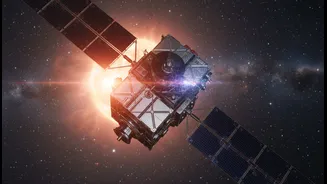
In a major setback for India’s burgeoning private space sector, Bengaluru-based startup GalaxEye Space announced on July 7 that it had lost contact with its marquee satellite, Mission Drishti. Launched in May 2026, the spacecraft was India's largest privately
developed Earth observation satellite and represented a technological milestone. However, during the final steps of its early orbit phase, a powerful geomagnetic solar storm appears to have fried a critical onboard system. Communication became intermittent before ceasing completely, and while recovery efforts continue, the chances of restoring contact are considered low.
The Sun’s Hidden Temper
So, what exactly is space weather? The term refers to the Sun's activity, which includes solar flares (intense bursts of radiation) and coronal mass ejections, or CMEs (massive clouds of solar plasma and magnetic fields). While flares reach Earth at the speed of light in just eight minutes, CMEs travel slower, taking days to arrive. When they do, they can trigger geomagnetic storms by interacting with Earth's magnetic field. These storms heat the upper atmosphere, causing it to expand. This increases atmospheric drag on low-Earth orbit (LEO) satellites, causing them to lose altitude faster. More critically, the high-energy particles from these events can damage or destroy sensitive satellite electronics, which is the suspected cause of Mission Drishti's failure.
A Burgeoning Industry Meets Reality
The loss of Mission Drishti is particularly poignant given the current momentum in India's private space industry. Three years after the government opened the sector, it has attracted hundreds of startups and significant investment, with companies like GalaxEye and Pixxel developing cutting-edge technologies. GalaxEye’s satellite was the world's first 'OptoSAR' craft, designed to combine optical and radar imaging to see through clouds and darkness—a crucial capability for surveillance and disaster management. The mission was hailed as a landmark achievement, highlighting how private firms are contributing to India's sovereign space capabilities. This incident, however, brings a harsh dose of reality to the ambitious sector, demonstrating that technological innovation must be paired with robust risk management for the harsh realities of space.
The High Cost of a Cosmic Blind Spot
This isn't the first time space weather has caused havoc. In February 2022, a geomagnetic storm destroyed up to 40 brand-new SpaceX Starlink satellites. The current solar cycle, known as Solar Cycle 25, is proving to be more active than predicted, increasing the frequency of such events. For India's private satellite operators, this means the risk of losing multi-crore assets is higher than ever. The lesson is clear: building a satellite is only half the battle. Ensuring it can survive the hostile environment of space, including unpredictable solar outbursts, is paramount. This event forces a crucial conversation about design, component hardening, and the economics of building for resilience.
Shielding Ambition for the Future
Despite the loss, GalaxEye's leadership has framed the mission as a source of invaluable engineering insight that will strengthen future spacecraft. The company is now reportedly accelerating plans to bring more of its supply chain and manufacturing in-house to better control for and protect against harsh space environments. The incident also validates the work of other Indian startups like Digantara, which is developing the world's first commercial, space-based weather monitoring system to provide better predictions and warnings. This solar lesson, though painful, will likely catalyze a new focus on building more robust systems, fostering a domestic supply chain for radiation-hardened components, and creating a more mature, resilient private space ecosystem in India.