








A Landmark National Project
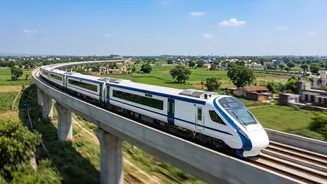
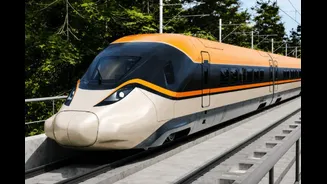
India's first bullet train project is officially known as the Mumbai-Ahmedabad High-Speed Rail (MAHSR) Corridor. Overseen by the National High Speed Rail Corporation Limited (NHSRCL), this 508-kilometre line will connect Maharashtra's financial capital
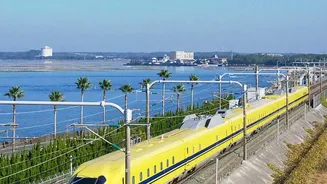
with Gujarat's largest city. The project is being developed with technical and financial assistance from Japan, utilising its world-renowned Shinkansen technology, which is famous for its safety and punctuality. The corridor passes through Maharashtra, Gujarat, and the Union Territory of Dadra and Nagar Haveli. It is designed to be a cornerstone of modern India, setting a template for future high-speed networks across the country.
The Route and a New Era of Speed
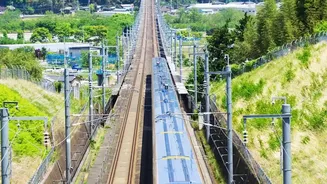
The MAHSR corridor will feature 12 stations: Mumbai (BKC), Thane, Virar, Boisar, Vapi, Bilimora, Surat, Bharuch, Vadodara, Anand, Ahmedabad, and Sabarmati. The train will operate at a speed of 320 km/h, drastically cutting travel time. A limited-stop journey between Mumbai and Ahmedabad is expected to take just under two hours, a significant reduction from the current seven to eight hours by conventional rail. Most of the 508-km line is elevated, but it also includes several tunnels, most notably a 21-km underground section with a 7-km undersea tunnel at Thane Creek.
Timeline: When Will It Be Ready?
Construction is progressing rapidly, with different sections set to open in phases. According to recent statements from the Railway Minister, the first section is expected to become operational in 2027. Testing on the indigenously made trainsets is slated to begin by May or June 2027. While an initial service on the Surat-Bilimora stretch is targeted for August 2027, the entire 508-km corridor is projected to be fully completed by 2029. Civil work on key sections in Gujarat, like Vapi-Surat, is nearing completion, with significant progress made on laying tracks, erecting piers, and building stations.
The Price of Progress
Large-scale infrastructure projects of this nature come with a significant cost. The initial estimate for the MAHSR project in 2015 was ₹1.08 lakh crore. However, due to delays, including challenges in land acquisition and the impact of the COVID-19 pandemic, the cost has escalated. Recent estimates suggest the final project cost could be close to ₹2 lakh crore. The project is primarily funded through a soft loan from the Japan International Cooperation Agency (JICA), covering approximately 81% of the original cost at a very low interest rate. The remaining portion is funded through equity from the Government of India and the state governments of Gujarat and Maharashtra.
Technology and 'Make in India'
The project is a showcase of cutting-edge technology. It features Japan's E5 Shinkansen system, adapted for Indian conditions. A key component is the advanced electrification system, a 2x25 kV Overhead Traction System being used for the first time in India to ensure a stable power supply for high-speed operations. Beyond importing technology, there is a strong 'Make in India' component. Many critical electrical components, such as transformers and cables, are being manufactured domestically. Furthermore, state-owned BEML is developing indigenous bullet train prototypes, with the first body frame recently completed for testing, signalling a major step towards self-reliance in high-speed rail manufacturing.
More Than Just a Fast Train
The benefits of the bullet train extend far beyond reduced travel time. The project is a massive economic driver, expected to create jobs and boost industrial activity along the corridor. The construction phase alone has already generated significant employment. The corridor is anticipated to enhance connectivity between key economic hubs, fostering business and tourism. It will also serve as a crucial learning experience, building a domestic ecosystem for future high-speed rail projects. The Indian government has already identified seven additional high-speed corridors, and the lessons from the MAHSR project will be invaluable for this future expansion.