




A Ghost in the Machine
The story begins with a now-defunct galaxy known to astronomers as Gaia-Enceladus, or more informally, the 'Gaia Sausage'. This was a dwarf galaxy that roamed the cosmos billions of years ago. It wasn't a visible sausage-shaped object in the sky; the name
comes from a graph. When astronomers used data from the European Space Agency's (ESA) Gaia satellite to plot the velocities of stars in our galaxy, a distinct sausage-like shape appeared, revealing a group of stars moving on very strange, elongated orbits. These stars are the leftovers, a kind of galactic fossil record, of a massive object that our Milky Way consumed long ago. The Gaia Sausage galaxy had a total mass of more than 10 billion times that of our sun, making it a significant player in the early universe. Its discovery provided the first major clue to a pivotal event in our galaxy’s history.
The Collision That Reshaped a Galaxy
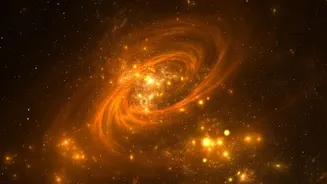
About 10 billion years ago, long before our own solar system formed, the Milky Way had a catastrophic, head-on collision with the Gaia Sausage. At that time, the Milky Way was smaller, and the Gaia Sausage was a substantial dwarf galaxy, perhaps about a quarter of the Milky Way's mass at the time of impact. The collision was not a quick event but a violent merger that unfolded over millions of years. The immense gravitational forces tore the Gaia Sausage apart, scattering its stars, gas, and dark matter throughout the young Milky Way. This influx of material had profound effects. The debris helped form the 'bulge' at our galaxy's center and the vast, spherical 'stellar halo' that surrounds the main disc. The merger also triggered furious bursts of star formation that lasted for billions of years, fundamentally altering the course of our galaxy's evolution.
Flipping the Galactic Disc
One of the most startling potential consequences of this cosmic smash-up is the reorientation of our entire galaxy. Recent research presented in July 2026 suggests this powerful, head-on collision may have literally flipped the Milky Way’s disc. Using supercomputer simulations, astronomers at Durham University found that such a merger could have tilted the galactic disc by more than 90 degrees, slowly swinging it into the orientation we observe today. This theory helps solve a long-standing puzzle: why the stars in the Milky Way's halo rotate so slowly compared to the stars in its main disc. The disc stars zip around the galactic center at about 220 kilometres per second, while halo stars lag far behind. The simulations showed that a disc-flipping event, caused by a Gaia Sausage-sized collision, would naturally produce a slow-moving stellar halo, just like the one we see.
How We Read the Cosmic Clues
Uncovering this ancient drama is a triumph of modern astronomy, made possible by the ESA's Gaia satellite. Launched in 2013, Gaia's mission is to create the most precise three-dimensional map of the Milky Way ever attempted. It meticulously measures the positions, movements, and brightness of nearly two billion stars. It's this incredibly detailed data on stellar motions that allowed astronomers to identify the 'sausage' stars in the first place. By tracing their unusual, highly radial orbits back in time, scientists could reconstruct the story of the merger. The Gaia mission has effectively given us the tools for galactic archaeology, allowing us to dig into our cosmic past and piece together the epic events that shaped the galaxy we call home.