





A Cosmic Flashlight
Imagine an explosion so powerful it can briefly outshine entire galaxies. That's a Gamma-Ray Burst, or GRB. These are the most energetic explosions in the universe, second only to the Big Bang itself. Most are thought to occur when a star far more massive
than our sun collapses at the end of its life, forming a black hole and blasting out jets of energy at nearly the speed of light. While the initial burst of gamma rays might last only seconds or minutes, it leaves behind a fainter, multi-wavelength 'afterglow' that can persist for days or weeks. For astronomers, these afterglows are like cosmic flashlights. As the light from a GRB travels across billions of light-years to reach us, it passes through its host galaxy and the vast spaces between galaxies. The gas and dust it encounters leave a distinct signature on the light, providing a priceless sample of what the universe was made of at that moment in time.
Peering Into the Dawn
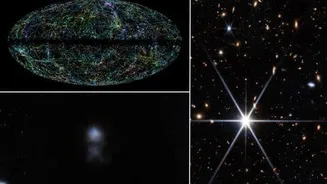
The headline-making event involves a specific burst named GRB 210905A. First detected in September 2021, its light traveled for over 12.8 billion years to reach Earth. This means the explosion happened when the universe was only about 880 million years old, a period known as the 'cosmic dawn'. This is when the first stars and galaxies were beginning to form and burn away the dark, neutral fog that filled the early cosmos in an era called the Epoch of Reionization. Finding a GRB from this far back is exceptionally rare. It provides a unique beacon to probe the conditions of a baby universe. Scientists using ground-based telescopes confirmed the immense distance of GRB 210905A, and the incredible brightness of its afterglow made it a perfect target for the most powerful eye in the sky: the James Webb Space Telescope.
Why Webb Is a Game Changer
Studying the earliest moments of the universe comes with a unique challenge. Because the universe has been expanding for 13.8 billion years, light from the most distant objects gets stretched out on its journey. Visible light from a primeval galaxy or explosion is shifted into longer, infrared wavelengths by the time it reaches us. The Hubble Space Telescope could see a sliver of the infrared spectrum, but Webb was built specifically to be a master of this domain. Its giant mirror and extreme sensitivity to infrared light allow it to see farther back in time, and with greater clarity, than ever before. For an event like GRB 210905A, Webb can analyze the faint afterglow to decipher the chemical makeup of its host galaxy, revealing what kinds of elements were present so early in cosmic history. This helps answer fundamental questions about where the building blocks of stars, planets, and even life came from.
What the Burst Revealed
Initial studies of GRB 210905A, including follow-ups with Webb, have already yielded surprising insights. One of the most stunning findings is how 'normal' this ancient explosion appears. Despite happening so early in the universe's timeline, its properties are remarkably similar to GRBs that have occurred much more recently and closer to home. This suggests that the fundamental physics driving these colossal stellar deaths has been consistent throughout cosmic history. Furthermore, observations of the GRB's host galaxy, made possible by instruments like the Hubble and Webb, show it to be one of the brightest galaxies ever found at such an extreme distance. This challenges previous assumptions about how quickly large, mature galaxies could form after the Big Bang and tells us that massive stars were living fast and dying hard very early on.