


An Unexpected Discovery
The star system Beta Pictoris, located a relatively close 63 light-years from Earth, is one of the most intensely studied neighbours in our galaxy. Astronomers already knew it hosted two massive planets, Beta Pictoris b and c. So when a team of researchers
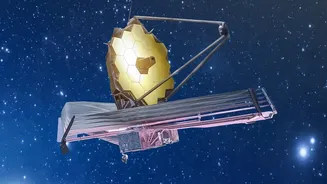
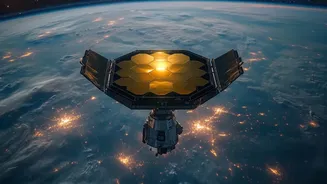
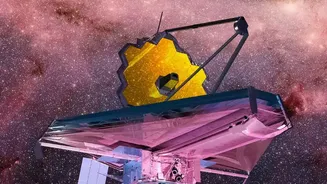
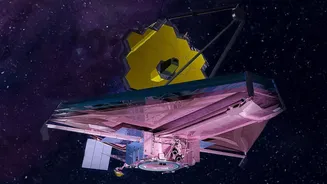
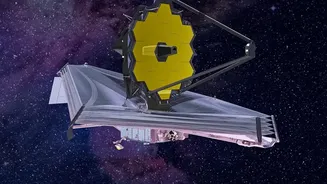
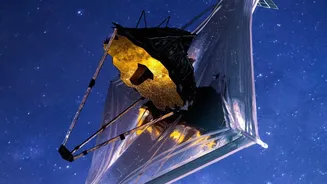
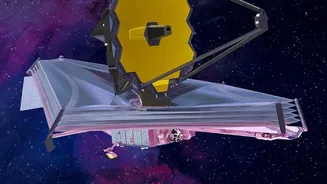
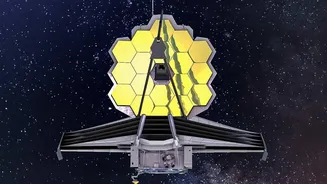
began pointing the James Webb Space Telescope (JWST) at the system, they weren't looking for another world. Their goal was to study the atmosphere of a known planet. But as they analysed the information gathered by Webb's Near-Infrared Spectrograph (NIRSpec), an unexpected signal appeared in the data. It was a telltale chemical fingerprint, a distinct pattern of light absorption that could only mean one thing: a third, previously unknown giant planet was orbiting the star.
Meet Beta Pictoris d
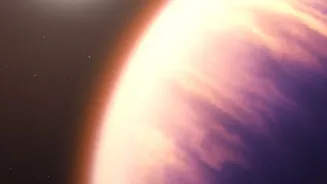
The newfound world, now named Beta Pictoris d, is a gas giant estimated to be at least twice the mass of Jupiter. Despite its immense size, it's actually the smallest of the three planets discovered in the system so far. It orbits its star at a distance comparable to Neptune's position in our own solar system, placing it on a wide path just inside the system's famous, bright debris disk. This makes Beta Pictoris only the second planetary system known to have at least three planets all captured by direct imaging techniques. The system itself is very young, at only about 23 million years old, providing scientists with a rare laboratory to see how planetary systems form and evolve in their turbulent infancy.
Hiding in Plain Sight
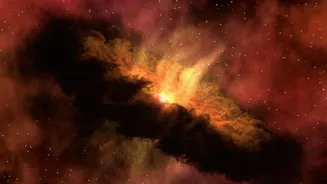
How could such a massive planet go unnoticed for so long in a system astronomers have watched for decades? The answer lies in the very feature that makes Beta Pictoris so famous: its massive, bright disk of dust and debris. This disk acts like a cosmic fog, scattering the light from the central star and making it incredibly difficult to spot the faint light of a planet using conventional imaging. The planet was effectively washed out by the glare. Previous searches came up empty because they were looking for a dot of light. But the team behind this discovery used a completely different method. Instead of trying to see the planet, Webb’s NIRSpec instrument was used to analyse the spectrum of light, hunting for the chemical signatures of a planetary atmosphere. The team found a barcode-like pattern indicating the presence of carbon monoxide, a feature expected in the atmosphere of a gas giant. They found the planet by its chemical fingerprint, not its picture.
A New Way to Find Planets
This discovery is more than just adding a new member to the Beta Pictoris family. It pioneers a powerful new technique for exoplanet hunting. It is the first time a directly imaged planet has been found primarily through this kind of moderate-resolution spectroscopy. The success of this method shows that astronomers can now find worlds hidden in complex and messy environments, like bright debris disks, that were previously inaccessible. According to lead researcher Aidan Gibbs, the team wasn't even looking for a new planet, which makes the find all the more significant. This accidental discovery proves that even in well-studied corners of space, major discoveries can still be waiting in the data archives, ready to be uncovered by new tools and fresh approaches.