
A Planet in Constant Motion
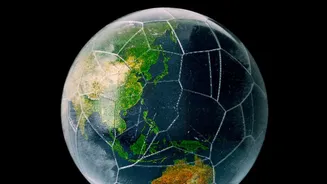
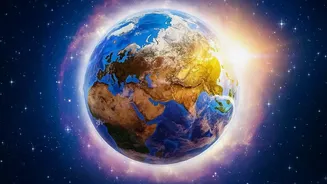
The ground beneath our feet feels solid, but it’s actually a collection of massive tectonic plates that are always moving, floating on the semi-molten mantle below. This movement is incredibly slow, typically just a few centimetres per year, about the speed
your fingernails grow. But over millions of years, this gradual drift reshapes the globe entirely. The engine driving this process is found deep within the Earth. At mid-ocean ridges, like the one running down the middle of the Atlantic, new crust is formed, pushing continents apart. Conversely, in other areas known as subduction zones, oceanic crust is forced underneath continental plates and recycled back into the mantle. The Pacific Ocean is famously encircled by these subduction zones, known as the 'Ring of Fire'. This ring is essentially acting like a bathtub drain for the ocean, causing it to shrink inch by inch, year after year.
The Supercontinent Cycle
This continental shuffling is part of a grand cycle. Every several hundred million years, the continents collide and merge to form a massive single landmass, or a supercontinent. The most famous of these was Pangaea, which existed around 300 million years ago and united nearly all the Earth's land. If you were around then, you could have walked from modern-day India to North America without crossing a major ocean. Eventually, the heat building up underneath Pangaea caused it to break apart, leading to the arrangement of continents we see today. Scientists have identified evidence of even earlier supercontinents, such as Rodinia and Nuna, suggesting this cycle of assembly and breakup has been happening for billions of years. The big question for geologists now is not if, but how and when the next supercontinent will form.
Welcome to Amasia
Several competing theories exist, but a leading model, backed by powerful supercomputer simulations, predicts the formation of a supercontinent named Amasia. The name comes from the idea that America will collide with Asia. In this scenario, the relentless subduction around the Pacific's Ring of Fire continues. The Americas are pulled westward, while Australia drifts north, eventually slamming into Asia. This slow-motion continental pile-up will completely close the Pacific Ocean. Researchers at Australia's Curtin University project this will happen in the next 200 to 300 million years. The Atlantic Ocean, which is currently widening, would become the planet's dominant superocean in this scenario.
An Alternate Future: Aurica and Other Models
Science is rarely settled, and other models propose different futures. One alternative suggests the Atlantic, not the Pacific, will eventually stop expanding and begin to close. This would lead to a supercontinent called Pangaea Proxima (or Pangaea Ultima), where the continents reassemble in a configuration more similar to the original Pangaea. Another prominent model proposes the formation of 'Aurica'. In this scenario, both the Pacific and Atlantic oceans close, and all the world's continents merge into a single landmass clustered around the equator about 250 million years from now. The debate between these models—known as introversion (closing the young ocean like the Atlantic) versus extroversion (closing the old ocean like the Pacific)—depends on complex factors like the strength of the oceanic crust. Current evidence seems to be favouring the extroversion model, which leads to Amasia.
A World Transformed
The formation of a supercontinent like Amasia would create a world drastically different from our own. Sea levels are expected to be lower, and the vast interior of the single landmass would become an extremely arid desert with punishing daily temperature swings. According to models from NASA scientists, an Amasia formed near the North Pole would be significantly colder than our current Earth, potentially triggering an ice age due to altered ocean currents and increased snowfall reflecting sunlight back into space. An Aurica formed at the equator, however, would be much warmer. While these mind-bending timelines are far beyond human experience, they offer a profound perspective. They remind us that the world map is not a finished product but a single frame in an epic geological story that is still being written.