







A Planet Hiding in Plain Sight
In a remarkable breakthrough, astronomers using NASA's James Webb Space Telescope (JWST) have discovered a new exoplanet using a revolutionary technique. They found the planet, named Beta Pictoris d, not by seeing the world itself, but by detecting the unique
chemical fingerprint of its atmosphere. This is like identifying a flower in a vast field by its scent rather than its colour. The discovery was made in the Beta Pictoris system, a well-studied stellar neighbourhood just 63 light-years from Earth. This system was already known to host two other giant planets, making it a valuable natural laboratory for understanding how planetary systems form and evolve. However, Beta Pictoris d was effectively hidden within a bright, messy disc of cosmic dust and debris, which made traditional detection methods nearly impossible.
The Old Way vs. The New Way
For decades, finding planets around other stars has relied on two primary methods. The transit method watches for a tiny, periodic dip in a star's light, which happens when a planet passes in front of it. The other, direct imaging, involves using a special mask called a coronagraph to block the star's overwhelming glare, hoping to spot the faint dot of a planet's reflected light. Direct imaging is incredibly difficult because even giant planets can be millions of times fainter than their host star. The new method, demonstrated with the discovery of Beta Pictoris d, sidesteps these challenges. Instead of looking for a dot of light, Webb's powerful spectrographs looked for specific molecular signals that are characteristic of a planetary atmosphere. The team used Webb's Near-Infrared Spectrograph (NIRSpec) to find tell-tale signs of carbon monoxide, water vapour, and methane, confirming the presence of a massive gas giant without ever seeing it as a distinct point of light.
More Than Just a Faint Dot
This spectroscopic approach is a monumental leap forward because it does two jobs at once: it discovers the planet and begins to characterise its atmosphere in a single observation. Traditional methods find a dot and then require follow-up observations to learn anything about its atmosphere, if possible at all. By identifying the planet through its atmospheric gases, scientists immediately have a window into its composition and temperature. This is crucial for distinguishing actual planets from other celestial objects or even instrumental glitches. This new power will be especially valuable for finding planets in complex, dusty environments like the Beta Pictoris system, where young worlds are still forming. It allows astronomers to cut through the cosmic 'fog' and find planets that were previously undetectable. It offers a richer, more detailed picture from the moment of discovery.
Pioneering the Search for Other Worlds
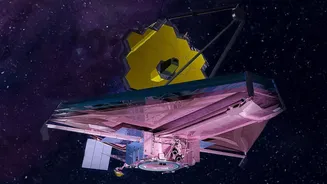
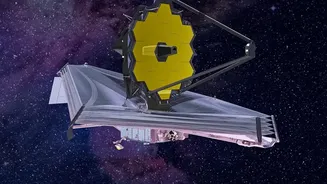
The ability to detect a planet by its atmospheric 'glow' is more than just a clever trick; it fundamentally expands the toolkit for astronomers. The James Webb Space Telescope's incredible sensitivity to infrared light is the key. This is the type of light that holds the thermal signatures of distant worlds and the chemical fingerprints of the gases in their atmospheres. While Webb has been used to study the atmospheres of known planets, this is a powerful demonstration of using the atmosphere itself as the primary detection signal. This technique could prove essential in the ongoing quest to find smaller, rockier worlds. As the methods are refined, scientists hope to apply similar principles to search for the atmospheric signatures of Earth-like planets, potentially identifying worlds with conditions that might be favourable for life. The discovery of Beta Pictoris d shows that some of the universe's biggest secrets aren't hiding in the darkness, but are waiting to be revealed by their own unique chemical voices.