

What Exactly Is a 'Fire Rainbow'?
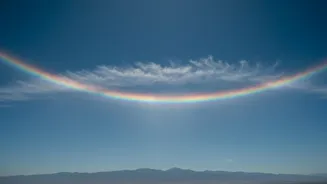
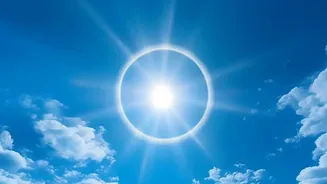
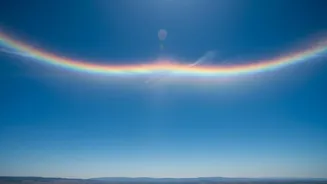
Despite its dramatic name, a fire rainbow is neither fire nor a traditional rainbow. The correct scientific term is a circumhorizontal arc. It’s an optical phenomenon belonging to a family of atmospheric light shows called ice halos. These arcs appear
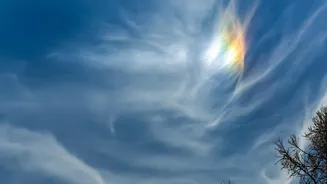
as a broad, vibrant band of colours running parallel to the horizon, often looking like a section of a rainbow has been flattened out across the sky. The colours are known for being particularly pure and spectral, even more so than in a typical rainbow, with red always appearing as the topmost colour. The nickname comes from its flame-like, colourful appearance when seen in patchy cirrus clouds.
A Precise Recipe of Ice and Light
For a circumhorizontal arc to form, the sky needs a very specific set of ingredients. First, there must be high-altitude cirrus clouds, which are thin, wispy clouds found above 20,000 feet where temperatures are low enough for water vapour to freeze. These clouds must contain tiny, plate-shaped hexagonal ice crystals. Crucially, these millions of microscopic crystals need to be aligned horizontally, like countless tiny floating plates. Sunlight then enters through a vertical side face of these crystals and exits through the bottom horizontal face. This 90-degree refraction of light acts like a prism, splitting the sunlight into its component colours and projecting them across the sky.
The Sun's Critical Angle
Perhaps the most important factor is the position of the sun. A circumhorizontal arc can only be seen when the sun is very high in the sky, specifically at an elevation of more than 58 degrees above the horizon. This is why the phenomenon is more common during the summer months in mid-latitude regions and is typically observed closer to midday. For example, a city like Los Angeles has hundreds of hours per year where the sun is high enough, while in London, the window of opportunity is much smaller. In locations north of 55°N or south of 55°S, the sun never gets high enough in the sky for a circumhorizontal arc to be visible at all.
How It's Different From a Rainbow
It's easy to confuse a fire rainbow with a regular one, but they are formed by entirely different processes. A classic rainbow is created by sunlight refracting and reflecting through liquid water droplets, usually raindrops. This is why rainbows always appear in the part of the sky opposite the sun. You need the sun behind you and rain in front of you to see one. A circumhorizontal arc, however, is created by sunlight refracting through ice crystals and always appears on the same side of the sky as the sun, located far below it. While a rainbow is an arch centred on the point directly opposite the sun, a fire rainbow is a horizontal line.
A Rare and Fleeting Sight
The strict requirements for the sun's elevation and the presence of correctly oriented ice crystals make circumhorizontal arcs a relatively rare sight. You have to be in the right place at the right time, looking up when the atmospheric conditions are just perfect. Often, the halo-forming cloud is small or patchy, meaning only fragments of the arc are seen, rather than a long, continuous band. These fleeting displays are a powerful illustration of the complex physics at play in our atmosphere, turning a simple combination of ice and light into a spectacular, colourful display that continues to capture our imagination. The phenomenon can also be confused with cloud iridescence, but iridescence has more random, washed-out colours, while a circumhorizontal arc has a fixed, spectral order.