


A New Sentinel in the Solar System
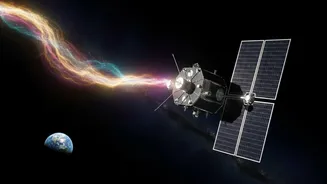
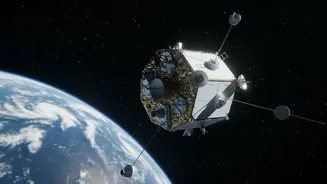
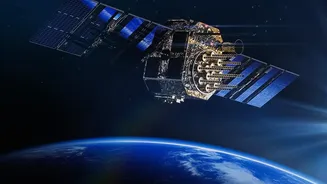
Launched in September 2025, NASA's Interstellar Mapping and Acceleration Probe (IMAP) is on a crucial mission. From its orbital post about 1.5 million kilometres from Earth, it has a unique, sun-facing vantage point. Its primary job is to act as a celestial
cartographer, charting the complex and invisible boundaries of our solar system. The probe's suite of ten advanced instruments was designed by an international coalition to intercept and analyze particles streaming from the sun and the vast, unknown space between the stars. This first public release of data, collected by seven of those instruments, marks the official beginning of a new era of discovery.
Decoding the Solar Wind
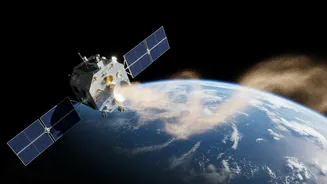
The sun constantly releases a stream of charged particles—mostly protons and electrons—that flows outward in all directions at speeds approaching a million miles per hour. This phenomenon is known as the solar wind. This isn't a gentle breeze; it's a powerful force that carves out a massive bubble in the interstellar medium, the material that fills the space between stars. This bubble, called the heliosphere, envelops our entire solar system and acts as a crucial shield, protecting the planets, including Earth, from a significant amount of harsh galactic cosmic radiation. IMAP’s instruments are designed to directly sample this wind, measuring its composition, temperature, speed, and the magnetic fields it carries.
What the First Data Stream Shows
This initial dataset provides scientists with their first taste of IMAP's capabilities. The information comes from instruments like SWAPI (Solar Wind and Pickup Ion), which measures particles from both the solar wind and those drifting in from interstellar space, and the MAG (Magnetometer), which tracks the sun's magnetic field as it travels through the system. While the data is still preliminary, it offers an unprecedented, high-fidelity look at the ingredients of our local space environment. Scientists can now begin to piece together a more detailed picture of how particles are accelerated to incredible speeds and how the solar wind’s structure evolves as it journeys billions of miles from the sun.
Protecting Technology and Astronauts
Understanding the solar wind is more than just an academic exercise. The same solar wind that creates beautiful auroras can also wreak havoc on our technologically dependent society. Intense bursts, known as solar storms, can disrupt satellite communications, damage power grids on the ground, and pose a serious radiation risk to astronauts in space. IMAP plays a vital dual role here. Beyond its primary science mission, it serves as an advanced space weather sentinel. Its real-time data stream, called I-ALiRT, gives forecasters about a 30-minute head start on potentially hazardous solar events, which is critical for protecting assets and future crews on missions to the Moon and Mars.
Mapping Our Place in the Galaxy
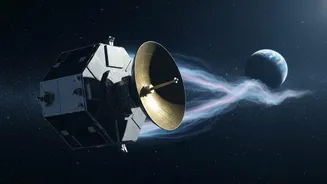
Ultimately, IMAP is helping us understand our solar system’s relationship with the rest of the Milky Way galaxy. By studying particles from both inside and outside our heliosphere, the probe is mapping the dynamic boundary where our sun's influence ends and interstellar space begins. This interaction defines our cosmic home. The data will help answer fundamental questions about the composition of the local interstellar neighborhood and how this protective bubble formed and evolved. For scientists, it’s like finally getting a clear weather report from the very edge of our solar system, allowing them to understand the forces shaping our environment on a galactic scale.