


A Celestial Lion's Portrait
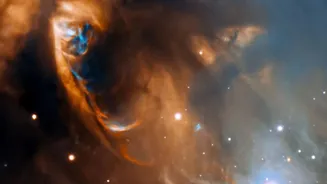
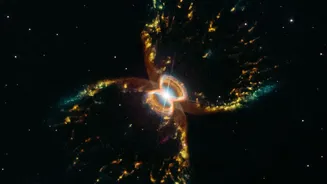
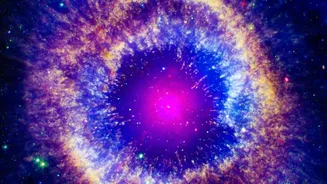
The subject of this stunning new portrait is officially known as NGC 2392, a planetary nebula located thousands of light-years from Earth. A planetary nebula, despite its name, has nothing to do with planets. Instead, it represents the dramatic final
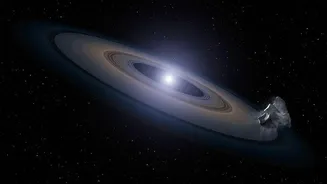
act in the life of a star similar to our own Sun. When such a star runs out of fuel, it becomes unstable and sheds its outer layers of gas and dust into space. What remains at the center is an incredibly hot and dense stellar core called a white dwarf. In the case of the Lion Nebula, this central white dwarf, which looks like a bright button nose, is furiously blasting radiation outwards, sculpting the surrounding material into the intricate shapes we see.
Through the Eyes of Webb
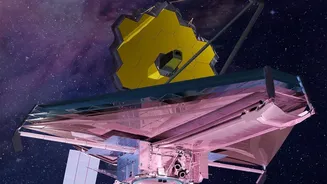
While the Hubble Space Telescope gave us our first glimpse of the Lion Nebula's face back in 2000, the James Webb Space Telescope's powerful infrared instruments have peeled back new layers, offering a much clearer and more detailed view. Webb's vision cuts through the haze, highlighting features that are difficult to see in visible light. The new composite image, combining data from Webb’s Near-Infrared Camera (NIRCam) and Mid-Infrared Instrument (MIRI), shows a cavernous bubble of ionized gas forming the lion's face, surrounded by a magnificent, flowing mane. This mane is composed of a dusty shell illuminated by the central star, featuring complex rings and filaments.
Rings and Clumps of Cosmic Dust
The headline features of Webb's new image are the delicate rings and dense clumps of dust within the nebula's structure. Astronomers are particularly interested in why the expanding bubble of gas forms these complicated arrangements of rings and shells, a common but not fully understood feature of planetary nebulae. The image also reveals comet-like tufts within the lion's mane. These are compact clumps of dust that have remarkably managed to withstand the intense radiation from the dying star. In a fascinating cosmic dance, these resilient clumps act as shields, protecting the material located behind them from being blasted away by the fierce stellar winds.
A Snapshot of Stellar Evolution
Observing the Lion Nebula is like looking at a single frame in a very long, slow-motion movie of cosmic creation and destruction. The gas and dust we see have been evolving for several thousand years since being cast off by the central star. The intense energy from the white dwarf is constantly changing the nebula's appearance, creating a bubble of ionized gas that expands and sweeps away the dust in its path. This process is responsible for producing much of the observable dust in the universe—the very material that can one day form new stars and planets. Webb's observation captures this fleeting moment in the nebula’s life. Astronomers estimate that in about 10,000 years—a blink of an eye in cosmic terms—the entire structure will disperse into space.