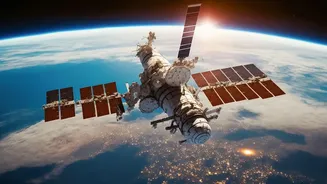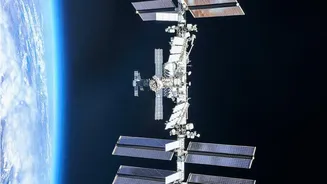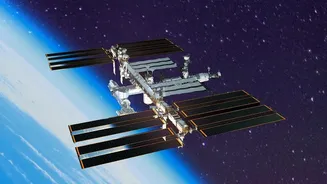


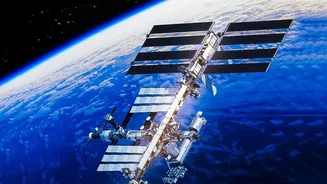
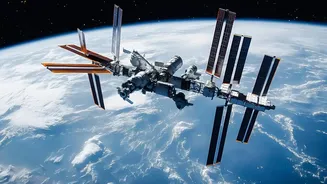
The International Space Station just received a major power-up. After a multi-year effort involving complex spacewalks, NASA has finished installing eight new-generation solar arrays, securing the orbiting laboratory's scientific future.
Why the ISS Needed a Power Boost
The International
Space Station (ISS) has been continuously inhabited since November 2000, serving as a premier laboratory for scientific research in microgravity. Its original solar arrays, designed for a 15-year lifespan, have been powering the station for over two decades. While still functional, they have shown expected signs of age-related degradation, with their power output gradually decreasing over time. This created a growing power deficit that risked limiting the station's ability to support an increasing number of advanced scientific experiments, technology demonstrations for future missions to the Moon and Mars, and commercial activities. To ensure the station could continue operating at full capacity, a significant upgrade was essential.
Introducing the iROSA Solution
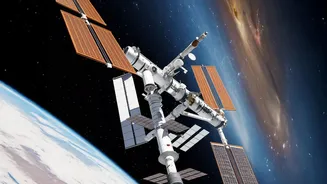
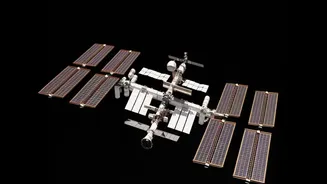
The solution came in the form of the ISS Roll-Out Solar Arrays, or iROSAs. Unlike the station's original rigid, foldable panels, the iROSAs are a groundbreaking technology. They are lighter, more compact for launch, and highly efficient. Transported to the station rolled up in a compact cylinder, they are designed to unfurl like a giant mat or a measuring tape, using stored potential energy rather than complex motors. Though smaller in size than the old arrays they supplement, each new iROSA generates a comparable amount of power. The project involved installing eight new arrays in total, delivered in pairs by SpaceX Dragon cargo spacecraft. They were strategically placed to partially overlay six of the station's eight existing power channels, boosting their output significantly.
A Marathon of Spacewalks
Installing these arrays was a monumental task, requiring a carefully orchestrated series of spacewalks that began in 2021. Over the course of five years, four different pairs of astronauts ventured outside the station to complete the upgrades. The final installation, completed on November 5, 2026, was performed by NASA astronaut Anil Menon and Canadian Space Agency astronaut Joshua Kutryk. Their spacewalk lasted nearly seven hours, during which they mounted the 750-pound (340 kg) array onto a pre-installed bracket on the station's main truss. The entire upgrade project involved 18 separate spacewalks to prepare the worksites and install the eight arrays, culminating in the 286th spacewalk in support of station assembly and maintenance.
Powering the Future of Science
With the final iROSA unfurled, the station's total available power has increased from 160 kilowatts to approximately 215 kilowatts—a boost of about 30 percent. This additional electricity is critical for the station's mission through its planned retirement in 2030. The power surge will support a new generation of scientific instruments and technologies, allowing for more complex research in fields like biology, physics, and materials science. It also provides the necessary power for NASA's technology demonstrations related to the Artemis program, which aims to return humans to the Moon, and for future deep space exploration. The enhanced power supply ensures the ISS can remain a bustling hub of discovery and a vital testbed for the technologies that will carry humanity farther into the solar system.