






Cosmic Objects Stuck in the Middle
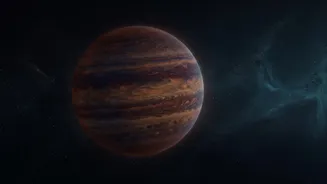
Imagine a star, a colossal furnace powered by nuclear fusion, and a planet like Jupiter, a giant ball of gas. A brown dwarf is something in between. They are born from the collapse of a gas cloud, just like stars, but they never gain enough mass to kick-start
the hydrogen fusion that makes stars shine for billions of years. Often called 'failed stars', they are more massive than any planet in our solar system but fall short of the stellar threshold. After their initial formation, they don't have a stable internal engine. Instead, they simply spend the rest of their existence cooling down and fading, glowing dimly with leftover heat from their birth. This slow cooling process makes them fascinating laboratories for understanding planetary and stellar evolution.
A Case of Cloudy, Turbulent Weather
The atmosphere of a brown dwarf is a chaotic place. Unlike the clear skies you might imagine in space, these worlds are shrouded in clouds, but not of water vapour. Their clouds are made of exotic materials like molten iron, silicates, and salts. One of the biggest puzzles for astronomers is what happens to these clouds as the brown dwarf cools over millions of years. Scientists observe a dramatic transition where older, cooler brown dwarfs appear to have much clearer atmospheres than their younger, hotter counterparts. This shift is surprisingly abrupt, and current models have struggled to fully explain how these thick, planet-enshrouding clouds break up and dissipate. Understanding this 'cloud-clearing' event is crucial to piecing together the life cycle of these unique objects.
A New Eye on the Infrared Sky
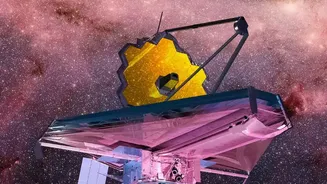
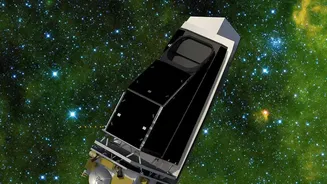
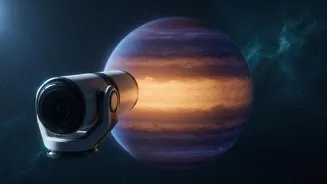
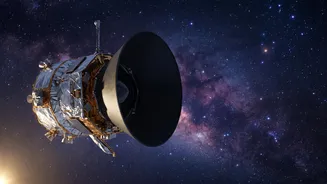
Enter NASA’s SPHEREx telescope, short for Spectro-Photometer for the History of the Universe, Epoch of Reionization, and Ices Explorer. Launched in 2025, this space observatory is designed to map the entire sky in near-infrared light, which is invisible to the human eye but perfect for spotting dim, cool objects like brown dwarfs. While other telescopes like the James Webb Space Telescope can study individual objects in great detail, SPHEREx's strength is its all-sky survey. It will create a massive catalogue, capturing data on hundreds of thousands of celestial bodies, including an unprecedented number of brown dwarfs. By measuring the infrared light spectrum, SPHEREx can identify the chemical fingerprints of molecules like methane and carbon dioxide in their atmospheres, providing the raw data needed to solve the atmospheric puzzle.
What the Latest Findings Reveal
Recent findings from the SPHEREx mission offer new clues. By surveying thousands of brown dwarfs at different temperatures and ages, scientists are building a more detailed timeline of their atmospheric evolution. The data suggests that the cloud-clearing process is not a gentle, gradual dissipation. Instead, as the brown dwarf cools, the exotic clouds made of rock and iron likely break apart into patchy, turbulent sections. This fragmentation would cause the object's brightness to vary significantly before the cloud decks eventually sink deeper into the atmosphere, below the visible layers. This 'break-up' model helps explain the rapid transition observed, where the atmosphere goes from being completely overcast to relatively clear. Models are still struggling to perfectly match the data around this cloudy transition, but SPHEREx is providing the most detailed view yet.
Why Brown Dwarfs Matter
Studying these failed stars isn't just about satisfying cosmic curiosity. Because brown dwarfs are isolated objects, their atmospheres are much easier to study than those of exoplanets, which are often washed out by the blinding light of their host stars. The atmospheric physics of a cooling brown dwarf—how its clouds form, move, and dissipate—is incredibly similar to what happens in the atmospheres of gas giant exoplanets. By understanding the weather on a brown dwarf, we gain invaluable insights into the conditions on planets orbiting other stars. The work being done by SPHEREx helps refine the models used to characterize distant worlds, bringing us one step closer to understanding the vast diversity of planets throughout our galaxy.