

Our Perfect Cosmic Laboratory
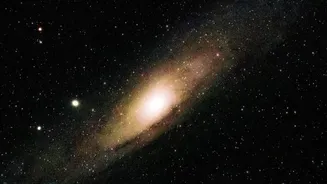
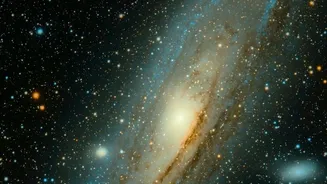
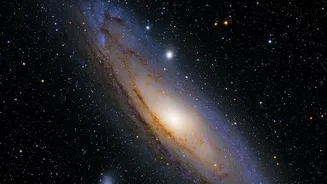
To understand how galaxies like our own Milky Way grow and change, we need an outside perspective. Being inside the Milky Way makes it impossible to see its full structure. Andromeda, also known as M31, provides the perfect solution. It's a large spiral
galaxy, similar in many ways to our own, but we can view its entire sprawling disc. This unique vantage point allows astronomers to study the complete life cycle of a galaxy. Think of it as a giant, cosmic experiment running next door, offering clues to our own past and future. Years of observations have been dedicated to this galactic neighbor, including monumental survey projects that have mapped its stars in incredible detail.
Hubble's Star-Finding Toolkit
Reading the clues in Andromeda requires special tools. The Hubble Space Telescope is not just a powerful camera; it can see light invisible to the human eye, particularly in the ultraviolet (UV) spectrum. This is crucial for studying star formation. The most massive, young stars burn incredibly hot and fast, emitting huge amounts of UV light. By looking for this blue glow, astronomers can pinpoint the stellar nurseries where stars have recently been born. In contrast, older, cooler stars glow redder. The color of a star, therefore, acts as a fossil record, telling astronomers about its age and the history of its birthplace.
Mapping a Galactic History
To piece together Andromeda's story, astronomers undertook a massive project called the Panchromatic Hubble Andromeda Treasury (PHAT), later supplemented by the Panchromatic Hubble Andromeda Southern Treasury (PHAST). Together, these surveys spent years taking thousands of high-resolution images, creating a gigantic mosaic of a large portion of the galaxy's disk. They resolved over 200 million individual stars. To analyze this immense dataset, researchers divided the galaxy's image into thousands of smaller sections and studied the mix of stars within each one. This allowed them to create a detailed map showing where and when stars have formed throughout Andromeda's recent history.
A Galaxy Winding Down
The story told by these stellar maps is one of a galaxy in transition. While Andromeda had a major burst of star formation about two billion years ago, likely triggered by a merger with a smaller galaxy, its pace has slowed considerably since. Recent studies show that over the last 500 million years, star production has been steadily declining. This slowdown has become even more dramatic in the last 40 million years, with the current rate plummeting to about one-fifth of a solar mass per year. Much of the remaining activity is concentrated in a prominent ring of gas and dust about 32,000 light-years from the galactic center. This suggests Andromeda is not running out of fuel but is naturally winding down, entering a more quiescent phase of its life.
Clues for Our Own Future
Studying Andromeda’s evolution provides a forecast for our own galaxy. The Milky Way is currently more active, creating stars at a higher rate than our neighbor. However, the processes happening in Andromeda—the gradual quieting of star formation and the concentration of activity in specific regions—offer a glimpse into the long-term lifecycle of large spiral galaxies. Ultimately, the fates of our two galaxies are intertwined. Andromeda is on a collision course with the Milky Way, and in about 4.5 billion years, they are predicted to merge into a single giant elliptical galaxy, an event that will trigger a massive, final burst of star formation before activity ceases. By reading the clues in Andromeda today, we are, in a sense, reading a chapter from our own cosmic destiny.