








An Industry Under Threat
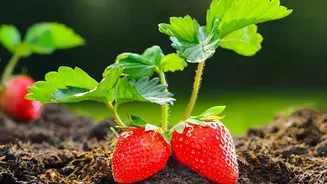
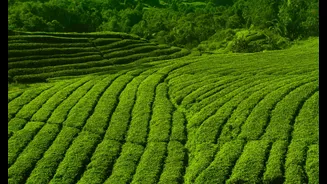
For generations, the hills of Mahabaleshwar have provided the perfect climate for strawberry cultivation, accounting for about 85% of India's total production. But that delicate balance is breaking. Farmers are now grappling with a devastating combination
of erratic weather patterns, from unseasonal heatwaves to extreme cold snaps. Temperatures soaring above 30°C in early spring cause strawberries to ripen too quickly, resulting in smaller, less flavourful fruit unfit for the market. This can slash yields by as much as 40%. Sudden heavy rains or cyclones can wipe out an entire field overnight, turning a season's investment into a massive loss. With the ideal growing temperature for strawberries being a narrow 15°C to 25°C, these climate fluctuations have turned a reliable livelihood into a high-stakes gamble.
Growing Up, Not Out
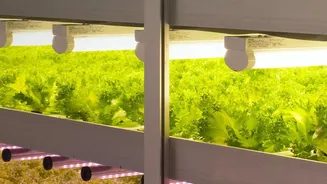
In response, some farmers are looking inwards and upwards with vertical farming. This method involves growing crops in stacked layers inside a controlled environment, like a polyhouse. It almost completely decouples farming from the unpredictable weather outside. By regulating factors like temperature, humidity, and light, growers can create the perfect conditions for strawberries year-round. This technique significantly reduces the risk of crop failure from heat stress or heavy rains. Furthermore, vertical systems are incredibly resource-efficient. They can use up to 95% less water than traditional soil-based farming because water is recirculated, a crucial advantage in a region facing increasing water scarcity. By growing upwards, farmers can also produce far more in a smaller land area, optimizing their output without needing more space.
The Digital Weather Shield
Alongside vertical farming, Artificial Intelligence (AI) is being deployed as a digital shield against climate uncertainty. Startups and government initiatives are offering AI-powered platforms that give farmers hyper-local weather forecasts and real-time advice. In Mahabaleshwar, some farmers are using systems that employ weather-monitoring towers and AI to predict with precision when rain will strike. This allows them to time the spraying of expensive pesticides and fungicides so they aren't immediately washed away, saving significant costs. Other AI applications use on-farm sensors to track soil moisture and nutrient levels, providing tailored recommendations for irrigation and fertilizer use. This data-driven approach, often accessible through a simple smartphone app, helps farmers make informed decisions to optimize resource use, reduce costs, and ultimately protect their crops from climate risks.
Promise Meets Practicality
The combination of these technologies holds immense promise, but the path to widespread adoption is filled with practical hurdles. The primary barrier is cost. The initial investment for a vertical farming setup can be substantial, ranging from several lakhs to over a crore depending on the scale and level of automation. These systems also have significant operational expenses, particularly for electricity to power lights and climate control systems, which can account for up to 40% of running costs. Similarly, while AI advisory apps like MahaVISTAAR are gaining traction, reaching over 30 lakh farmers in Maharashtra, challenges in digital literacy and connectivity remain. Farmers require new skills to manage these high-tech systems, a gap that needs to be addressed through training and support. While early adopters are seeing benefits in yield consistency and resource savings, scaling these solutions to the region's thousands of smallholders will require a concerted effort.
A Blueprint for Indian Agriculture?
The experiments in Mahabaleshwar are more than just a story about strawberries; they serve as a potential blueprint for the future of Indian agriculture in a changing climate. As weather patterns become more volatile across the country, the need for climate-resilient farming practices is urgent. Controlled Environment Agriculture (CEA), which includes vertical farming, is a rapidly growing market in India, projected to expand at a CAGR of 17.5%. The success of these high-tech models for a high-value crop like strawberries could pave the way for their adoption for other fruits and vegetables. For this to happen, government support through subsidies, coupled with innovation from AgriTech startups focused on bringing down costs, will be crucial. The trials in Mahabaleshwar are a critical test case, demonstrating how blending technology with traditional farming can create a more sustainable and profitable future for farmers nationwide.