


A Sky Crowded with Ambition
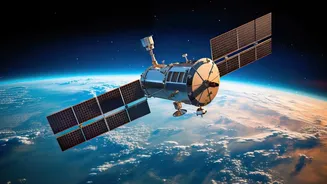
Low-Earth orbit (LEO), the invisible highway arching a few hundred kilometres above our heads, has become dramatically more congested. In early 2019, there were just over 2,000 active satellites orbiting Earth. Today, that number has ballooned to over 18,000,
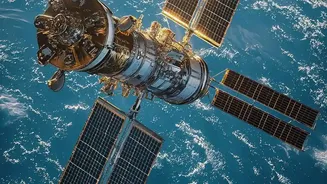
with the vast majority of them in LEO. This orbital real estate is now home to a rapidly growing population of spacecraft, from scientific instruments to the mega-constellations that provide global internet. According to the European Space Agency (ESA), intact satellites or rocket bodies are now re-entering the atmosphere more than three times a day on average. The primary driver of this explosive growth is the commercialisation of space, led by companies like SpaceX with its Starlink constellation, which alone accounts for over 10,000 active satellites. This surge in traffic is fundamentally changing our relationship with the space above us.
What Goes Up Must Come Down
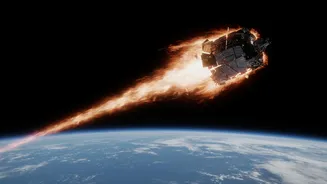
Every satellite has a limited lifespan, typically around five years for modern constellations. To avoid becoming hazardous space junk, older satellites must be removed from orbit. This is where re-entry comes in. There are two main types: controlled and uncontrolled. A controlled re-entry uses a satellite's final fuel reserves to steer it towards a remote, unpopulated area, usually the South Pacific Ocean Uninhabited Area, nicknamed 'Point Nemo'. Uncontrolled re-entries, however, are far more common. These occur when a defunct satellite or rocket part is simply left to fall, its orbit gradually decaying due to atmospheric drag. The exact location where it will come down can only be predicted in the final hours, making it a game of orbital roulette. The recent increase in re-entries is a direct consequence of the sheer number of new satellites being launched; it's a planned part of the constellation business model, which relies on constantly replacing older models.
A Numbers Game of Risk
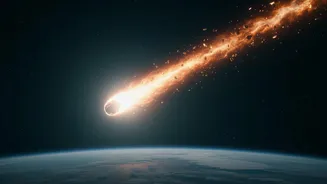
The pressing question is obvious: Is it dangerous? For any single individual, the odds of being hit by a piece of falling space debris are exceptionally low. Most of our planet is covered by water, and large parts of the land are uninhabited. Furthermore, most of a satellite burns up due to the intense heat—over 1,600°C—generated by friction with the atmosphere. However, not everything disintegrates. Dense components made of titanium, stainless steel, or glass can survive the fiery descent and reach the ground. NASA estimates that 10-40% of a satellite’s mass can survive. While there has never been a confirmed human death from falling space debris, the increasing frequency of re-entries inherently increases the overall, collective risk. We are moving from a situation of near-zero risk to a low but growing one, with recent incidents including large metal fragments landing in populated areas.
Tracking the Descent
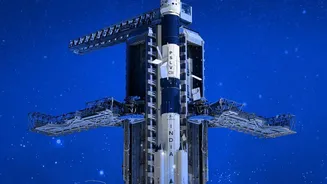
Global space agencies operate a sophisticated network of ground-based radars and telescopes to keep tabs on the tens of thousands of tracked objects in orbit. Organisations like ESA and national bodies like India's ISRO, with its Project NETRA, are dedicated to monitoring space debris and predicting re-entry trajectories. This allows authorities to issue warnings and, if necessary, close airspace. However, tracking is not a perfect science. Solar activity, for instance, can cause the Earth's atmosphere to expand, increasing drag on satellites and making their descent less predictable. The sheer volume of objects—including millions of smaller, untracked pieces—makes the task a monumental challenge.
A New Kind of Pollution
Beyond the physical risk of impact, this constant rain of vaporised satellites is introducing a new form of pollution into the upper atmosphere. As spacecraft burn up, they release tiny particles of metals like aluminum, lithium, and other compounds. Scientists are concerned that this metallic dust could have unforeseen consequences, potentially affecting the ozone layer, altering the atmosphere's chemical balance, and even subtly changing the climate. Recent measurements have already detected a significant increase in metallic particles in the stratosphere that are directly attributable to spacecraft re-entry. While the long-term effects are still unknown, it’s clear that our activities in space are beginning to have a measurable impact on the Earth's environment.