







An Ocean World Full of Promise
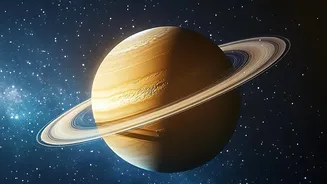
Enceladus may look like a small, quiet ball of ice, but it's one of the most dynamic and promising worlds in our solar system. Only about 500 kilometers in diameter, this moon of Saturn is covered by a bright white, highly reflective icy shell. For decades,
scientists were puzzled by its pristine surface. The answer, discovered by NASA's Cassini spacecraft, was stunning: Enceladus is an active world, spraying geyser-like jets of water vapor and ice particles from its south pole into space. These plumes originate from a vast, global ocean of liquid saltwater hidden beneath the ice. This subsurface ocean, possibly kept warm by hydrothermal vents on the seafloor, contains many of the chemical ingredients considered essential for life, including organic compounds. The fact that Enceladus conveniently ejects samples of its ocean into space makes it a top-tier target for astrobiologists.
Recreating an Alien Ocean in the Lab
While we can't yet drill through the moon's ice, scientists can bring its ocean to Earth—in a manner of speaking. In a groundbreaking new study, researchers meticulously recreated the chemical conditions thought to exist on the seafloor of Enceladus. This wasn't just a simple saltwater solution. The laboratory concoction simulated the highly alkaline environment (with a pH up to 11), low oxygen levels, high carbonate concentration, and the presence of powdered rock to mimic water-rock interactions near hydrothermal vents. The team then introduced a specific type of Earth-based microbe, an archaeon called Methanothermococcus okinawensis. This single-celled organism is an extremophile, found thriving near deep-sea hydrothermal vents in the oceans of Earth, and it doesn't require oxygen.
Surprising Signs of Survival
The results of the experiment surprised even the researchers involved. The microbes didn't just survive in the harsh, simulated Enceladus ocean; they thrived. Despite the extreme alkalinity, which is typically inhospitable, the organisms grew and produced methane. They adapted their metabolism, using the hydrogen produced by the simulated water-rock reactions as an energy source and figuring out how to utilize the available carbon dioxide to grow. The study, published in Science Advances, demonstrates that a known form of life can withstand the unique and challenging geochemistry of Enceladus. It doesn't prove that life exists there, but it removes a significant barrier, confirming that the moon's environment is not fundamentally prohibitive to a metabolism that is one of the most ancient on Earth.
Strengthening the Case for New Missions
This finding significantly bolsters the argument for sending new, dedicated life-detection missions to Enceladus. The Cassini mission found methane in the moon's plumes, but couldn't determine if its origin was biological or geological. This new research shows that biological methanogenesis is a plausible explanation. A concurrent study also found that as ocean water erupts through the ice, the freezing process may naturally separate and concentrate different chemical compounds into individual ice grains. This is fantastic news, as it means a future spacecraft flying through the plumes might find it easier to detect key biosignatures—the chemical fingerprints of life—because nature is doing some of the sample preparation for us.
The Next Frontier: Orbilander and Beyond
The scientific community is already dreaming up ways to get back to Enceladus. One of the leading concepts is a NASA flagship mission called the Enceladus Orbilander. This ambitious probe would first orbit the moon, flying through its plumes multiple times to analyze fresh samples with advanced instruments, before attempting to land on the icy surface for a multi-year investigation. Other proposed missions, like the Enceladus Life Finder (ELF), have also been designed specifically to assess the habitability of the internal ocean by sampling the plumes. While these missions are still in the proposal stage, the compelling evidence from Cassini and new laboratory studies like this one make the scientific case for returning to Saturn's shimmering moon stronger than ever.