

Hunga Tonga-Hunga Ha'apai, Tonga (2022)
The eruption of the underwater Hunga Tonga-Hunga Ha'apai volcano in January 2022 was an event unlike any other in the modern era. Confirmed as the largest explosive eruption of the 21st century, its power was hundreds of times greater than the atomic
bomb dropped on Hiroshima. The blast sent a sonic boom rippling around the globe, heard as far away as Alaska. Instead of just ash and gas, this submarine eruption blasted an unprecedented amount of water vapour—an estimated 146 million tons—into the stratosphere. This massive injection of water was enough to temporarily warm the Earth's surface and is expected to remain in the atmosphere for years. The eruption column soared to a record height of 58 kilometres, punching into the mesosphere. It generated a devastating tsunami that impacted several Pacific nations, causing fatalities and widespread destruction in Tonga.
Puyehue-Cordón Caulle, Chile (2011)
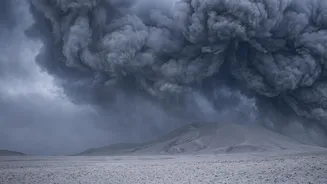
In June 2011, after 51 years of inactivity, the Puyehue-Cordón Caulle volcanic complex in Chile roared to life with one of the century's largest events. Rated a 5 on the Volcanic Explosivity Index (VEI), the eruption was on par with the famous 1980 Mount St. Helens event. It unleashed an estimated one hundred million tons of ash, sand, and pumice, releasing energy equivalent to 70 Hiroshima bombs. The most significant impact was a colossal ash cloud that circled the entire Southern Hemisphere. This created travel chaos for weeks, grounding flights in cities across South America, Australia, and New Zealand as the plume made its way around the globe. For months after the initial blast, winds continued to stir up the settled ash in Patagonia, causing further disruptions.
Eyjafjallajökull, Iceland (2010)
While not the largest in terms of sheer explosive power (rated a VEI 4), the 2010 eruption of Iceland's Eyjafjallajökull is famous for its outsized global impact. The eruption occurred beneath a glacier, a combination that proved uniquely disruptive. The interaction of hot magma and melting ice created a plume of fine, glassy ash that was carried by jet streams directly towards Europe. This ash is highly dangerous to aircraft engines, as it can melt and solidify inside, causing engine failure. In response, authorities implemented the largest air-traffic shutdown since World War II. For over six days, European airspace was largely closed, cancelling over 100,000 flights and stranding millions of passengers worldwide. The crisis cost the airline industry over a billion euros and highlighted the vulnerability of our modern, interconnected world to a single geological event.
Mount Merapi, Indonesia (2010)
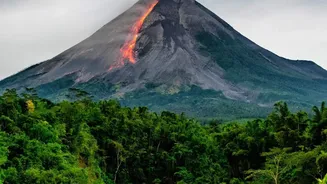
Just a few months after Iceland's disruption, Mount Merapi in Indonesia—one of the country's most active and dangerous volcanoes—produced its largest eruption in over a century. Beginning in late October 2010, a series of violent eruptions sent deadly pyroclastic flows—fast-moving currents of hot gas and volcanic matter—down its slopes. The events had a devastating human toll, killing over 350 people and forcing the evacuation of around 350,000 more from the densely populated surrounding areas. Ash plumes caused significant disruption to aviation across Java. The eruption served as a grim reminder of the direct and deadly threat volcanoes pose to communities living in their shadow, contrasting with eruptions whose main impact is on global travel.