




The Problem With Asteroids
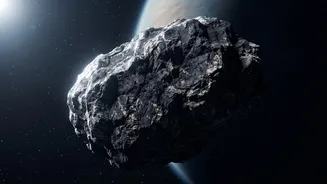
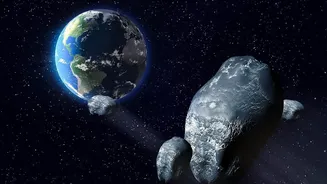
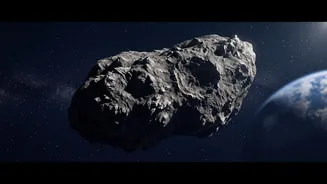
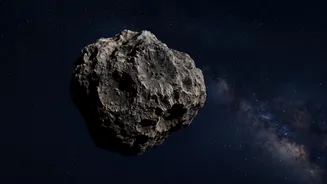
Deflecting an asteroid isn't as simple as just hitting it hard. Asteroids aren't perfect spheres; they are lumpy, irregularly shaped rocks tumbling through space. This means that the effect of any attempt to push one—whether with a kinetic impactor like
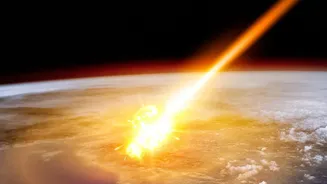
NASA's DART mission or a nuclear detonation—is incredibly hard to predict. Previous computer models had to make a choice: either use a simplified, spherical shape for the asteroid to run complex physics calculations, or use a realistic shape but with simplified physics. According to Sandia physicist Nathan Moore, this was a major limitation because spherical asteroids simply don't exist in the real world. This trade-off left a major gap in our ability to reliably plan a defensive mission. Getting it wrong could be disastrous, as a poorly aimed push could fail to move the asteroid enough, or worse, break it into multiple hazardous pieces.
A New Era of Simulation
Sandia National Laboratories has developed a new model that eliminates this trade-off. For the first time, defence planners can use a tool that incorporates both realistic, lumpy asteroid shapes and high-fidelity physics calculations. The breakthrough was achieved by combining two of Sandia's existing simulation programs: ALEGRA, which is used for high-energy events, and SPARTA, which models more slowly evolving effects. This combined approach allows researchers to model how the X-rays from a nearby nuclear burst would vaporise material off an asteroid's uneven surface, creating a push that alters its course and rotation. Crucially, this new algorithm is over 1,600 times faster than older methods, making complex and detailed simulations practical for the first time.
Why Shape and Aim Matter
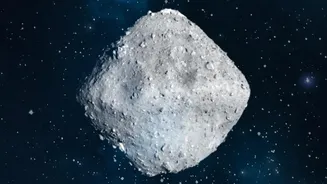
The new simulations have already yielded surprising results. Researchers ran tests on detailed models of known asteroids like Bennu and Itokawa and found that where you aim is critically important. On one simulated lumpy asteroid, hitting one side produced a deflection velocity nearly five times greater than hitting another side. The change in the asteroid's spin could be even more dramatic, varying by a factor of 17 depending on the target point. As Moore stated, 'We expected aim to matter. What surprised us was how much.' This discovery transforms planetary defence planning from guesswork into a precise science. Instead of treating an asteroid as a generic target, planners can now understand how its specific topography—its ridges, slopes, and hollows—will influence the outcome of a deflection attempt.
From Theory to a Practical Playbook
This advanced model acts as a powerful planning tool. In a real threat scenario, mission planners could theoretically upload 3D imagery of the incoming asteroid, and the model would help calculate the optimal response. It can determine the best side to target, the ideal distance for a detonation, and the required explosive strength to nudge the asteroid onto a safe trajectory without shattering it. The simulations generate a detailed heat map showing how the surface will vaporise, allowing planners to predict the resulting change in both motion and spin. While challenges would remain—such as getting detailed data on an asteroid's shape in time and precisely positioning a device in deep space—this tool significantly reduces the uncertainties involved. It gives humanity a data-driven playbook for dealing with a threat that, until recently, was largely theoretical.