





The Challenge of a 'Flickering' Star
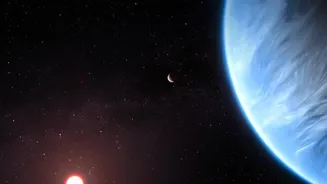
When astronomers study the atmosphere of a planet many light-years away, they use a clever technique called transit spectroscopy. As the exoplanet passes in front of its host star, a tiny fraction of starlight filters through the planet’s atmosphere.
By analyzing that light, scientists can detect the chemical fingerprints of molecules like water, methane, or carbon dioxide. However, there’s a significant complication: stars are not perfectly stable balls of light. Like our own sun, they have active regions, such as dark starspots and bright patches called faculae. These features can change as the star rotates, causing its brightness and light signature to vary. This stellar activity can create false signals that mimic a planet’s atmosphere or, conversely, hide the very signatures scientists are searching for. This issue, known as stellar contamination, makes it difficult to be certain whether a detected signal, like water, is truly from the exoplanet or is just noise from its parent star.
Enter Pandora, the Specialist
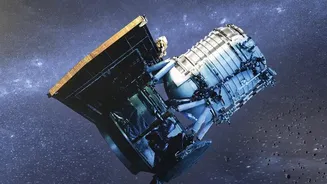
To solve this vexing problem, NASA launched the Pandora mission. Having commenced its science operations in August 2026, Pandora is a small, agile satellite, or SmallSat, developed as part of the agency's Astrophysics Pioneers program. This program fosters lower-cost, focused missions that can answer specific astronomical questions quickly and efficiently. Weighing about 325 kilograms, Pandora's entire job is to be a specialist, designed from the ground up to disentangle the mixed signals from stars and their planets. Led by NASA's Goddard Space Flight Center in collaboration with Lawrence Livermore National Laboratory and the University of Arizona, Pandora's primary mission will last for one year. During that time, it will study at least 20 different exoplanets to create a robust dataset that will help clean up observations from other telescopes.
A Tale of Two Light Beams
Pandora’s method is both elegant and effective. The satellite is equipped with instruments to observe a star system simultaneously in two different kinds of light: visible and near-infrared. When an exoplanet isn't transiting, Pandora stares at the star, using its visible-light photometer to track the star's brightness over time. This creates a detailed map of the star’s activity, charting how its spots and bright regions evolve and rotate. Then, when the planet does transit, Pandora uses its near-infrared spectrograph to capture the combined light from the star and the planet's atmosphere. Because scientists now have a clean baseline of the star’s own variability from the visible light data, they can confidently subtract the star’s “noise” from the infrared transit data. This process isolates the planetary signal, revealing a much clearer and more reliable picture of the exoplanet’s atmosphere.
Making the Webb Telescope Even Better
While Pandora is a powerful tool on its own, its true strength lies in its synergy with the James Webb Space Telescope. Webb is an incredibly powerful and in-demand observatory, meaning its observation time is precious. It cannot afford to spend 24-hour periods just staring at a single star to map its activity. This is where Pandora excels. As a cheaper, dedicated mission, it can perform these long-duration stares that are essential for correcting the stellar contamination problem. By doing this foundational work, Pandora provides the clean, contextual data needed to make Webb's shorter, more focused observations far more accurate. The collaboration is so close that Pandora’s near-infrared detector is actually a spare component originally built for the JWST, a direct link between the two missions. This allows astronomers to use Webb's powerful capabilities with much greater confidence, helping them prioritize which exoplanets are the most promising candidates for harboring life.