




The Planet's Fiery Engine
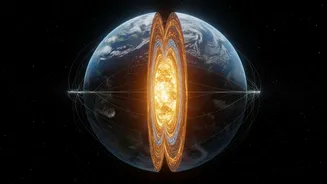
To understand this phenomenon, we first need to journey to the centre of the Earth. Our planet has a core made of two parts: a solid inner core roughly the size of the Moon, and a liquid outer core surrounding it. This outer core is a vast, turbulent
ocean of superheated, molten iron and nickel, swirling at temperatures as hot as the sun's surface. This constant motion of electrically conductive metal acts like a giant dynamo, generating the magnetic field that protects our planet from harmful solar radiation. For years, scientists believed this flow was relatively stable, with a dominant westward drift.
An Unexpected U-Turn
Recent analysis of satellite data has turned this long-held belief on its head. A study using measurements from several European Space Agency (ESA) missions, including Swarm and CryoSat, revealed a startling change. Around 2010, a huge section of this molten flow deep beneath the equatorial Pacific Ocean, which had been moving weakly westward, abruptly changed course and began flowing strongly eastward. This was a dramatic reversal that scientists had not anticipated, challenging previous assumptions about the stability of the core's circulation.
How Do Scientists Know This?
Since we cannot directly see the Earth's core, researchers rely on indirect methods. The primary tool is satellite magnetometry. Missions like ESA's Swarm constellation are incredibly sensitive and can map Earth's magnetic field with exceptional precision. By tracking subtle changes and wobbles in the magnetic field on the surface over many years, scientists can infer the speed and direction of the molten iron flowing thousands of kilometres below. Researchers analysed data from 1997 to 2025 to piece together a picture of this surprising reversal.
The Big Question: Why Did It Happen?
This is the part that has scientists both puzzled and excited. The short answer is: they don't know for sure. The event happened far more rapidly, over the course of just a few years, than most models of core dynamics would have predicted. Some researchers have hypothesized that the reversal might be linked to other changes happening even deeper inside the planet, possibly related to the behaviour of the solid inner core. There is evidence to suggest the inner core's rotation also slowed or changed around the same time, but the exact connection remains a topic of intense research.
A Short-Lived Fluctuation or Something More?
Another key question is whether this new eastward flow is a permanent change or just a temporary phase. The latest data suggests the strong eastward flow may have peaked around 2020 and is now weakening. This raises the possibility that the reversal is part of a repeating natural cycle or oscillation within the core. Scientists are now eager to see how the flow evolves in the coming years. Continued monitoring is essential to determine if the core's flow will return to its previous state or settle into a new equilibrium.
Should We Be Worried?
While a 'core flow reversal' sounds like something out of a disaster movie, scientists emphasize there is no cause for alarm. These processes are happening on geological timescales, thousands of miles below the surface, and pose no direct danger to life on Earth. However, understanding these dynamics is crucial. The magnetic field is vital for protecting our atmosphere and our technological infrastructure, including navigation systems and satellites, from solar radiation. Studying these changes helps us better understand the engine that powers our planetary shield.