







The Heart of the Matter
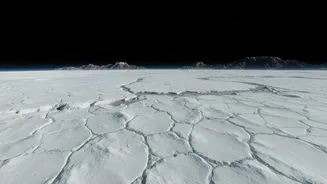
At the center of Pluto's surprising geology is a vast, bright basin called Sputnik Planitia, which makes up the western lobe of its iconic heart. This enormous plain isn't made of rock or water ice, but is filled primarily with soft nitrogen ice, along
with frozen carbon monoxide and methane. When NASA's New Horizons spacecraft flew by in 2015, it revealed that the surface of Sputnik Planitia is divided into a network of irregular polygons, typically 10 to 40 kilometers across. The complete lack of impact craters on this surface was a stunning discovery, implying that the region is incredibly young in geological terms—less than 10 million years old—and is being constantly renewed.
A Cosmic Lava Lamp
Scientists quickly realized that these polygonal shapes are the surface expression of a process called solid-state convection. Think of it like a giant, incredibly slow-moving lava lamp. Warmed by Pluto’s faint internal heat, the solid nitrogen at the bottom of the ice sheet becomes slightly less dense and buoyant, causing it to rise in large blobs. As it reaches the surface, it spreads out, cools, becomes denser, and then sinks back down along the edges of the polygons, or cells. This entire cycle is agonizingly slow, with surface motions averaging just a few centimeters per year—about the speed your fingernails grow. Even at that pace, it's enough to completely resurface the ice every 500,000 to one million years.
From Solid to Gas and Back Again
Another key process shaping Pluto is sublimation, where solid ice turns directly into gas without first becoming a liquid. Driven by weak sunlight, the sublimation of nitrogen ice at the surface helps power the convection by cooling the top layer, enhancing the cycle of rising and sinking. This constant refreshing of the surface helps support Pluto’s thin nitrogen atmosphere. But recent research suggests an even more complex plumbing system may be at work beneath the ice. Models indicate that heat from Pluto's interior could be enough to melt the nitrogen ice at the very bottom of the glacier.
A Leaky Heart
This is where the headline's claim comes into focus. A new analysis proposes that liquid nitrogen, created at the glacier's base, could be rising toward the surface. Liquid nitrogen is less dense than the solid ice, so it would naturally want to push its way upward through any available weaknesses, like cracks or fissures. Scientists believe these buoyant pockets of liquid could travel up through meter-wide conduits, eventually erupting onto the surface near the centers of the convection cells. From there, the liquid would flow outward toward the cell boundaries—the troughs that define the polygons—before refreezing. The dark streaks and patches seen along these troughs in New Horizons' images may be the tell-tale stains left behind by these recent flows, which could have happened within the last million years.
Why This Changes Everything
The evidence for recently flowing liquid on Pluto is a game-changer. It reinforces the idea that Pluto is not a dead, frozen ball of rock and ice but a complex, geologically active world. This process suggests a kind of cryovolcanism, where liquid nitrogen erupts like slow-motion lava, but at incredibly cold temperatures. This subterranean "plumbing" could explain features not only on Pluto but also on other distant, icy bodies like Neptune's moon Triton, which is known for its geysers. The discovery shows that even in the frigid outer reaches of the solar system, there can be enough energy to power vigorous and surprising geological activity.