







The Challenge of Modern SUVs
The rise of the electric vehicle has ushered in an era of large, heavy SUVs. Their long wheelbases, necessary to accommodate massive battery packs in the floor, create a spacious and stable ride on the highway. However, this same design makes them inherently
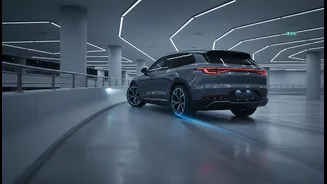
clumsy in urban environments. A long wheelbase means a wider turning circle, turning three-point turns into five-point sagas and making tight underground car parks a genuine source of anxiety. Automakers are faced with a fundamental geometry problem: how do you sell a large family vehicle that people are afraid to manoeuvre?
An Old Idea Gets a High-Tech Reboot
The solution, surprisingly, is not a new one. Rear-wheel steering, sometimes called four-wheel steering, first appeared on production cars in the 1980s. Early mechanical systems were clever but limited. Today, thanks to sophisticated electronics and powerful actuators, the concept has been perfected. It’s a key technology that allows engineers to give a large vehicle two distinct personalities: one for low-speed agility and another for high-speed stability.
The Low-Speed Magic Trick
The real game-changer for manoeuvrability happens at low speeds, typically below 40-60 km/h. When you turn the steering wheel to navigate a parking space or make a U-turn, the system turns the rear wheels a few degrees in the opposite direction of the front wheels. This action, known as counter-phase steering, effectively shortens the vehicle's wheelbase from a dynamic perspective. The result is a dramatically tighter turning circle. Some systems, like that on the Mercedes-Benz EQS SUV, can reduce the turning radius by over a meter, giving a massive SUV the turning circle of a compact car. This makes parking and navigating congested city streets remarkably stress-free.
Confidence and Stability at Speed
Once the vehicle's speed increases, the system's logic flips. At highway speeds, the rear wheels turn slightly in the same direction as the front wheels. This in-phase steering enhances stability during manoeuvres like lane changes. Instead of the rear of the car pivoting, the entire vehicle moves laterally with more grace and control, a feeling often described as the car 'crabbing' smoothly from one lane to the next. This reduces the amount of steering input needed from the driver and makes the vehicle feel more planted and secure, especially when towing or driving in crosswinds.
Why It's a Must for Big EVs
Rear-wheel steering has become particularly crucial for the new generation of large electric SUVs and trucks. These vehicles are not only long but also exceptionally heavy due to their batteries. This weight and length make them more challenging to handle with a traditional two-wheel steering setup. By adding rear-wheel steering, manufacturers like Lexus with its new TZ, GMC with the Hummer EV, and Hyundai with its Ioniq series can offer the large, family-friendly cabins customers demand without compromising on everyday usability. The technology directly counteracts the physical downsides of a heavy, long-wheelbase platform, making these giants feel surprisingly nimble.
Are There Any Downsides?
While the benefits are clear, the technology isn't without its trade-offs. Rear-wheel steering systems add cost, weight, and complexity to a vehicle. They are another component that could potentially require maintenance or repair down the line, and are typically reserved for higher-end models or as an optional extra. However, as more automakers invest in the technology, costs are likely to decrease. For many buyers navigating the reality of tight parking and crowded streets, the added manoeuvrability is a benefit that far outweighs the potential downsides.