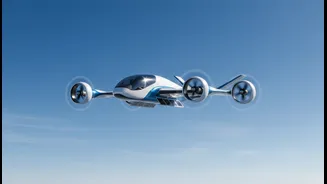






From Blueprint to Reality
In a significant leap for India's aviation ambitions, The ePlane Company, a startup incubated at IIT Madras, has officially unveiled its first full-scale electric aircraft prototype, the e200X. Designated PT-01, this milestone marks the transition from
computer simulations and small-scale models to a tangible, life-sized vehicle ready for rigorous evaluation. The company has now entered the critical ground-testing phase at its new state-of-the-art facility in Chennai. This stage involves subjecting the aircraft to a battery of structural and systems tests that simulate the immense pressures of flight. While the prototype has not yet taken to the skies, this phase is the direct precursor to flight trials, which are targeted to begin in mid-2027. This methodical process is essential for ensuring the vehicle is safe and reliable before its first ascent, moving the e200X from a concept to a machine on the cusp of flight.
What is the e200X Air Taxi?
The e200X is an electric Vertical Take-Off and Landing (eVTOL) aircraft. In simple terms, it takes off and lands like a helicopter but flies forward like a plane. This eliminates the need for long runways, a key feature for urban transport. The aircraft is designed to be one of the world's most compact passenger eVTOLs, with a footprint of just 8 by 11 meters, allowing it to operate from existing helipads and reinforced rooftops without requiring cities to build entirely new infrastructure. Built from a lightweight carbon-fibre composite, it can carry a pilot and two passengers, or alternatively, up to 200 kg of cargo. Its projected range is around 110 to 200 kilometers, with a cruising speed of 150-200 km/h, making it ideal for cutting through urban congestion. For safety, it uses a system of distributed electric propulsion, meaning multiple propellers and motors ensure that if one fails, the others can still land the aircraft safely.
India’s Race for Urban Airspace
The ePlane Company isn’t operating in a vacuum. A global race is on to define the future of urban air mobility (UAM), a market projected to be worth billions of dollars by 2030. In India, the potential is massive, with some estimates suggesting a demand for hundreds of millions of air taxi trips per month. The Indian government and regulators are actively paving the way for this new form of transport. The Directorate General of Civil Aviation (DGCA) has already issued guidance for certifying eVTOL aircraft and developing vertiports—the mini-airports they will use. This regulatory foresight gives startups like ePlane a clear path toward commercial operation. However, competition is heating up, with major players like InterGlobe Enterprises, the parent company of IndiGo, partnering with US-based Archer Aviation to launch an air taxi service in India by 2026. This makes ePlane’s progress on its indigenous design not just a technological achievement, but a crucial step in a high-stakes commercial contest.
More Than Just a Passenger Drone
While the vision of hopping into an air taxi to beat city traffic is compelling, ePlane’s strategy is broader and more versatile. The e200X has been designed as a multi-role platform. The same airframe can be configured for three distinct missions: passenger transport, cargo delivery, and emergency medical services. In fact, the company has already secured significant commitments for an air ambulance version of the aircraft, which could drastically reduce the time it takes to transport trauma patients to hospitals compared to road ambulances. For logistics, the e200X offers a zero-emission solution for moving time-sensitive goods across congested urban landscapes. This flexible approach allows the company to tap into multiple revenue streams and demonstrate the aircraft's utility in critical services first, potentially building public trust and operational experience before a wider passenger rollout.
The Long Journey to Hailing a Sky Cab
Unveiling a prototype is a major victory, but the journey to commercial service is still long and filled with challenges. The ground testing phase itself is an exhaustive process designed to find and fix flaws. Following that, the flight test program will involve thousands of hours of flying, first unmanned and then with pilots, to prove the aircraft's safety and performance under all conditions. Beyond the technical hurdles lies the complex world of certification. Every component and system must be approved by the DGCA, a rigorous process that ensures the aircraft meets the same high safety standards as commercial airliners. Finally, there is the challenge of building the ecosystem, which includes setting up vertiports, developing air traffic management systems for low-altitude airspace, and gaining public acceptance. While ePlane has made remarkable progress, the path ahead requires clearing these significant regulatory, infrastructural, and financial milestones.