



More Than Just A Single Rock
Not all asteroids are created equal. For decades, scientists have known that these remnants from the early solar system come in various compositions, from metal-rich to carbon-rich. But a more fundamental difference lies in their internal structure. Many
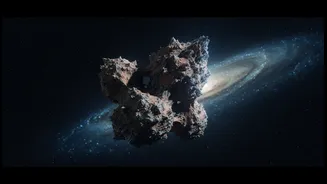
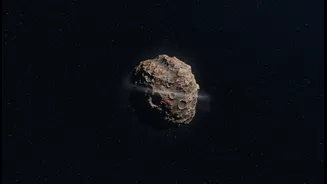
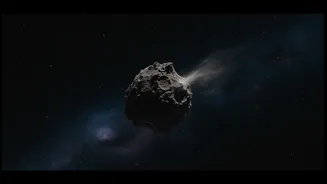
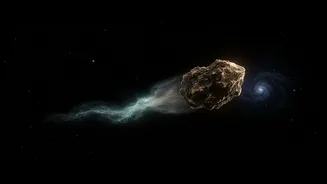
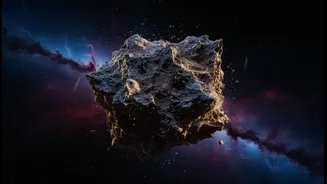
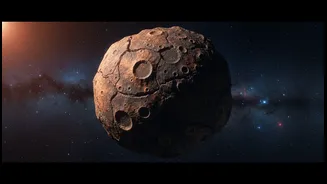
smaller asteroids are not monolithic boulders but are instead 'rubble piles'—a collection of numerous pieces of debris that have coalesced under their own weak gravity. These bodies are surprisingly porous, with large empty spaces and cavities between the chunks. Recent missions to asteroids like Bennu and Ryugu have confirmed that these cosmic sponges are far more common than once thought, especially for asteroids less than 10 kilometres in diameter. This distinction is crucial, as a solid rock and a pile of gravel behave very differently when you try to push them.
The Cosmic Wobble and Spin
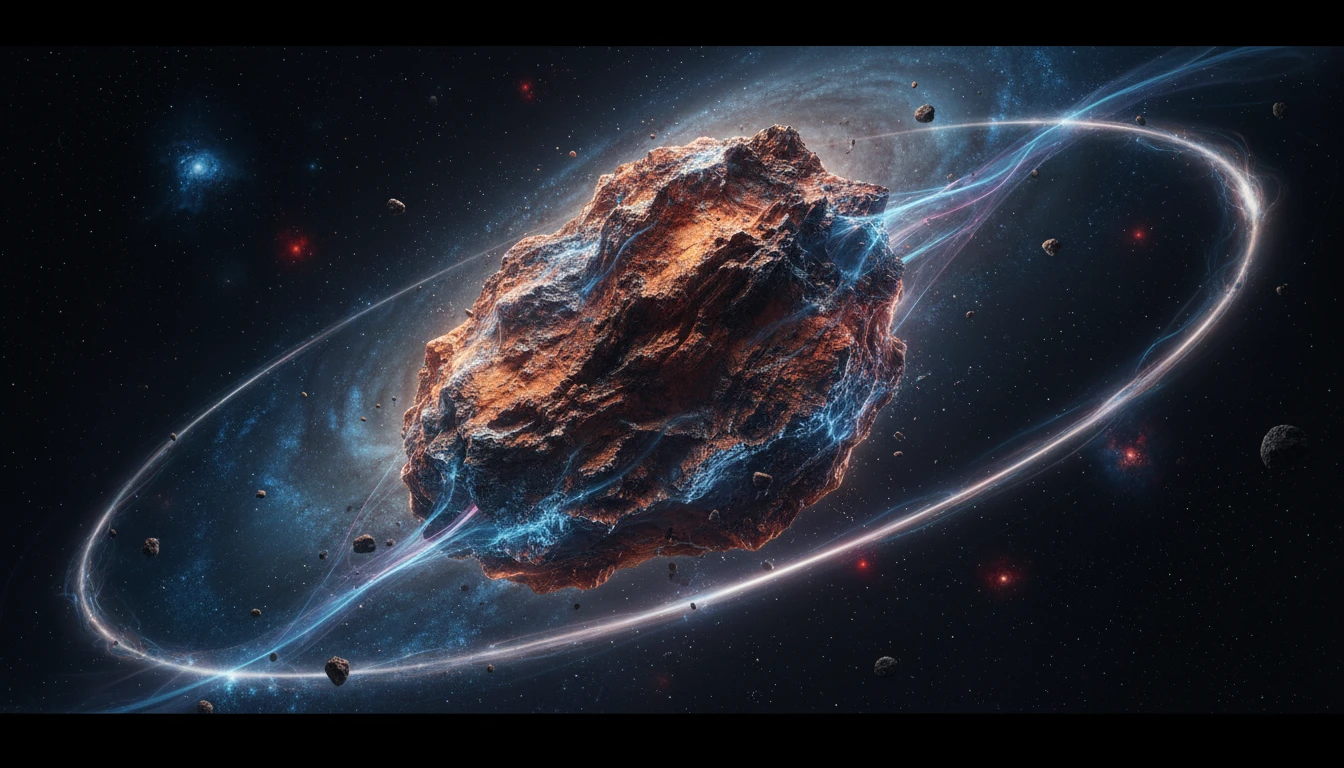
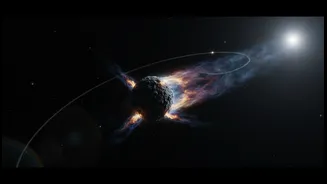
An asteroid's internal structure can be decoded by closely watching how it moves. One key phenomenon is the YORP effect, named after the scientists who theorized it. As an asteroid rotates, it absorbs sunlight and re-radiates that energy back into space as heat. This process creates a tiny, but continuous, push or recoil. If the asteroid has an irregular shape, these tiny forces don't cancel out, creating a net torque that can cause the asteroid to spin faster or slower over millions of years. By precisely measuring the change in an asteroid's spin rate, scientists can work backward. If the observed change doesn't match what's expected for a body with uniform density, it suggests a more complex interior. For instance, observations of the peanut-shaped asteroid Itokawa revealed that its two lobes must have different densities to explain its spin.
From Tumble to Composition
Beyond a steady change in spin, some asteroids exhibit a more chaotic motion: they tumble. Instead of rotating cleanly around a single axis, they wobble unpredictably. This tumbling behaviour provides another set of clues. Scientists have developed models linking this chaotic rotation to an asteroid's internal properties, like friction between its constituent pieces. Much like spinning a raw egg versus a hard-boiled one reveals what’s inside, observing an asteroid's spin during a close encounter with a planet like Earth can help map its density distribution. The gravitational pull of the larger body will make the asteroid respond differently depending on whether its mass is evenly distributed or concentrated in a dense core. These subtle wobbles, observed with powerful telescopes, become a vital data point for understanding an object's makeup.
Why This Matters for Planetary Defense
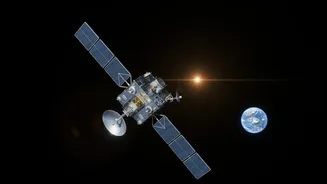
Knowing an asteroid's internal structure isn't just an academic exercise; it's critical for planetary defense. If we ever need to deflect an asteroid on a collision course with Earth, we need to know what we're pushing against. NASA's DART (Double Asteroid Redirection Test) mission, which successfully slammed a spacecraft into the asteroid moonlet Dimorphos in 2022, provided a real-world test. The mission showed that a kinetic impactor could alter an asteroid's orbit. However, the effectiveness of such a mission depends heavily on the target's composition. Pushing a solid rock is straightforward, but hitting a rubble pile is like punching a sandbag—it might just absorb the impact or break apart into multiple, still-dangerous fragments. Therefore, understanding whether an asteroid is a monolith or a rubble pile is essential for designing an effective deflection strategy.
The Future of Asteroid Forensics
The field of asteroid analysis is rapidly advancing. Missions that return samples, like Japan's Hayabusa2 from Ryugu and NASA's OSIRIS-REx from Bennu, provide pristine material that offers a ground truth for telescopic observations. These samples allow scientists to directly study the chemistry and physical properties of the materials that make up these rubble piles. In the coming years, advanced observatories and future missions will continue to refine these techniques. China has proposed a mission to both impact and observe an asteroid, gathering before-and-after data in a single campaign. By combining remote observations of motion with direct analysis from samples, scientists are building a comprehensive toolkit to not only understand the origins of our solar system but also to protect our place within it.