



The Planet's Faint Heartbeat
Imagine trying to hear a whisper in a crowded room. That’s the challenge facing scientists who are using seismology, the study of vibrations, to monitor glaciers. For decades, the faint, constant hum of the earth, often dismissed as background “noise,”
is now being seen as a vital source of information. Researchers have discovered that the movement of water under glaciers, the grinding of ice against bedrock, and the formation of deep cracks all produce subtle seismic tremors. By placing arrays of sensitive seismometers near glaciers, scientists can track these vibrations and detect changes that may signal instability. This new field, sometimes called cryoseismology, is turning the planet’s own vibrations into a powerful tool for predicting natural hazards like a sudden glacial collapse.
Decoding the Glacier’s Language
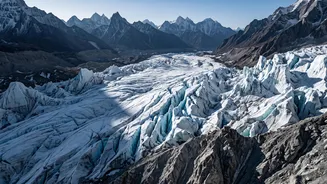
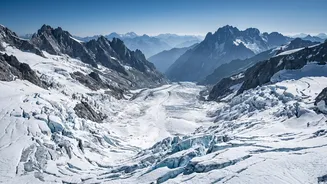
A stable, healthy glacier moves in a relatively predictable way. But when conditions change, so does its seismic signature. Studies have shown that an increase in seismic activity can precede major events. This signal can be caused by several factors, many of which are accelerating due to climate change. Warmer temperatures can cause meltwater to pool at the base of the glacier, lubricating it and making it more likely to slip. This water, moving through channels under the ice, generates a distinct tremor that scientists can track. Similarly, as ice fractures and crevasses form under stress, each crack releases a tiny pulse of energy. When these pulses become more frequent or intense, it suggests the glacier's internal structure is weakening, making it a candidate for a catastrophic failure.
The Specter of a GLOF
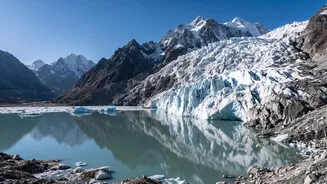
A glacial avalanche is not simply a slide of snow and ice. When a massive piece of a glacier breaks off, it can crash into a valley with immense force, often taking rock and debris with it. One of the most significant dangers is its potential to trigger a Glacial Lake Outburst Flood (GLOF). Many glaciers act as natural dams for large lakes formed from meltwater. If a chunk of the glacier falls into one of these lakes, it can displace a massive volume of water, causing the natural dam—often made of unstable rock and ice—to breach. The result is a sudden, violent flood that can travel dozens of kilometers downstream, destroying everything in its path. Communities in mountainous regions, from the Himalayas to the Andes, live under the constant threat of these events.
A Race Against Time for Early Warnings
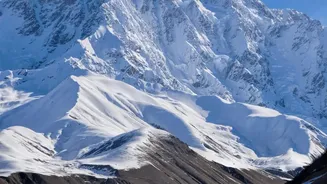
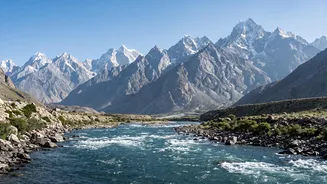
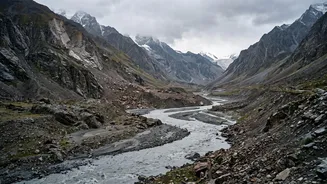
The ultimate goal of this research is not just academic; it's about saving lives. Traditional GLOF warning systems often rely on monitoring lake water levels, but these can be unreliable. Seismic monitoring offers a different approach—detecting the instability before the dam even breaks. In places like the Karakoram mountains in Pakistan, the Shisper Glacier's surge has repeatedly created dangerous ice-dammed lakes, threatening downstream communities and infrastructure like the Karakoram Highway. By using seismic data, researchers hope to provide more advanced warnings, giving authorities precious hours, or even days, to evacuate people. This is especially critical in remote regions where communication can be difficult and evacuation routes are limited.
From a Single Glacier to a Global System
The work being done to interpret these faint signals is a proof of concept for a much larger idea: a global network for monitoring glacial hazards. As climate change continues to warm the planet, glaciers worldwide are becoming more unstable, and the risk of GLOFs and avalanches is increasing. The techniques being honed today on individual glaciers could one day be applied more broadly, using satellite data in combination with seismic arrays to identify the most at-risk areas. While scientists caution that predicting these events with perfect accuracy is still a long way off, learning to listen to the whispers of a weakening glacier is a critical first step in adapting to our rapidly changing world and protecting the 15 million people estimated to be at risk from these hazards.