


The Rumors of a Flaw
The headline-making question about the Nancy Grace Roman Space Telescope’s primary mirror is not about a new problem discovered in space, but rather a hurdle faced during its construction and testing on Earth. Before its successful launch on August 30,
2026, reports had circulated for over a year about challenges with the mirror's ultra-thin silver coating. The concern centered on a phenomenon known as “crazing,” or the appearance of a web of microscopic cracks, and potential issues with the coating adhering to the glass. This is not a crack in the mirror itself, which is structurally sound, but an issue with the reflective layer that allows it to see the universe. NASA and its primary contractor, L3Harris Technologies, have been working on this issue for some time. While final inspections before launch in May 2026 showed the mirror passed all tests, the history of this technical challenge has left the science community watchful.
Why This Mirror is Different
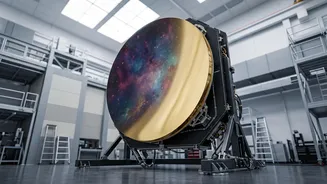
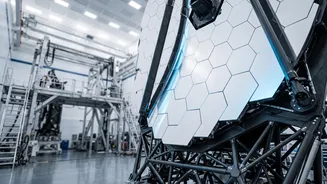
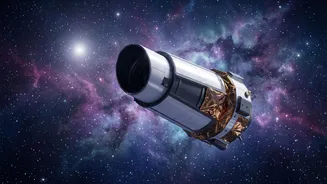
Roman’s 2.4-meter (7.9-foot) primary mirror is a marvel of engineering. It's the same size as the Hubble Space Telescope's, but that's where the similarities end. The mirror began its life as a surplus piece of hardware from the U.S. National Reconnaissance Office (NRO), given to NASA in 2012. To prepare it for its new mission, teams at L3Harris had to modify its shape and apply a new, exceptionally smooth surface. They chose a silver coating, which is more reflective for the near-infrared light Roman is designed to study, compared to the gold on the James Webb Space Telescope's mirrors. This silver coating is incredibly delicate, less than 400 nanometers thick. The surface is so precisely polished that if it were scaled to the size of Earth, the largest bump would be just a quarter of an inch high. This perfection is necessary, but the materials and process also introduce technical risks, like the crazing and adhesion issues that engineers have been working to solve.
A Mission to Uncover the Dark Universe
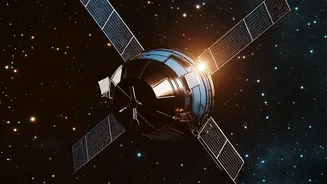
The stakes for Roman’s success are immense, which is why any question about its primary mirror draws so much attention. After launching aboard a SpaceX Falcon Heavy, the telescope is now on a 100-day journey to its operational orbit, a stable point nearly a million miles from Earth known as Lagrange Point 2. From there, it will embark on a five-year mission to tackle some of the biggest puzzles in astrophysics. Its primary goals are to hunt for the mysterious forces known as dark energy and dark matter, which together are thought to make up 95% of the universe. Roman will do this with its Wide Field Instrument (WFI), which provides a field of view 100 times larger than Hubble's, allowing it to map huge swaths of the sky with incredible speed and detail. Any degradation in the mirror's performance could compromise its ability to make the precise measurements needed for this groundbreaking research.
Testing New Technology for Future Missions
Beyond its own science goals, Roman is a crucial technology demonstrator for future observatories. The telescope carries a second instrument, an experimental Coronagraph designed to block the overwhelming glare of stars to directly image giant, Jupiter-like exoplanets for the first time. This instrument relies on advanced deformable mirrors, which can change their shape with thousands of tiny pistons to correct for minute imperfections in the telescope’s optics. The techniques and technologies being pioneered on Roman's coronagraph are intended to directly inform the design of NASA's next great flagship, the Habitable Worlds Observatory, planned for the 2040s. That future mission aims to directly image Earth-like planets, potentially identifying signs of life. The performance of Roman’s systems, from its primary mirror to its complex internal optics, serves as a vital testbed for this ambitious future.