




The Cosmic Ghost Particle
Trillions of particles called neutrinos pass through your body every second, yet you’ll never feel them. Often called “ghost particles,” they have almost no mass, no electric charge, and barely interact with matter at all. This trait makes them incredibly
difficult to detect, but also uniquely valuable. While light can be blocked by cosmic dust clouds, neutrinos can escape from the most violent and dense regions of the universe, carrying pristine information about their source. They are created by everything from nuclear reactions in our sun to massive exploding stars and supermassive black holes in distant galaxies. Catching one of these high-energy messengers is a monumental task, but it gives us a way to see parts of the universe that are otherwise invisible.
A Signal From the Ice
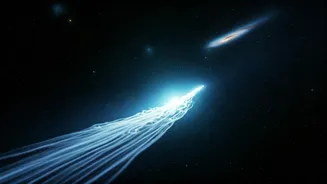
Deep beneath the South Pole, scientists have built a unique observatory to catch these cosmic ghosts. The IceCube Neutrino Observatory uses a cubic kilometer of pristine Antarctic ice, studded with over 5,000 light sensors. On the rare occasion a high-energy neutrino strikes an atomic nucleus in the ice, it creates a flash of blue light called Cherenkov radiation. By tracing the path of this light, scientists can determine the direction the neutrino came from. On September 22, 2021, IceCube detected just such an event: a single, very high-energy neutrino logged as IC 210922A. An alert was immediately sent to astronomers around the world, triggering a massive search to find its origin.
Unmasking the Shadow Blaster
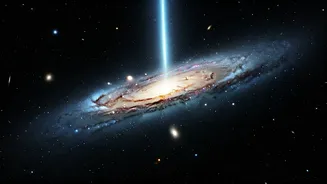
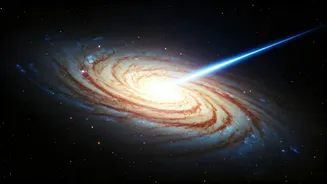
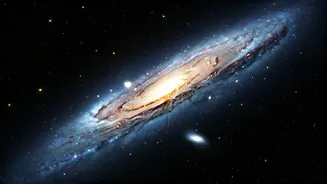
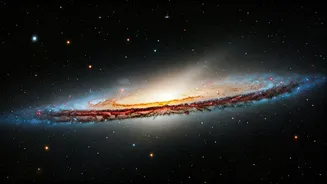
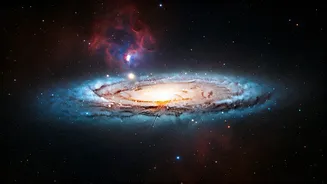
Initially, the search for the neutrino's source was frustrating. Astronomers scanned the designated patch of sky with optical, X-ray, and gamma-ray telescopes but found nothing—no exploding star, no flaring black hole. Then, a team led by researcher Yuji Urata decided to look at longer wavelengths using radio telescopes. They found a remarkably bright object that was almost invisible in visible light, a galaxy so shrouded in dust that it was effectively hidden. Nicknamed "Shadow Blaster," the galaxy (officially JCMT0402−0424) is a dusty, compact galaxy undergoing a furious period of star formation. Its immense brightness was further amplified by a cosmic coincidence known as gravitational lensing, where a closer galaxy bent and magnified its light, making it easier for telescopes to study.
A New Kind of Cosmic Engine
This discovery, published in Nature Astronomy in June 2026, challenges previous assumptions about where high-energy neutrinos come from. Until now, the few confirmed sources were active galactic nuclei (AGNs), where supermassive black holes devour matter and shoot out powerful jets. Shadow Blaster, however, showed no signs of a monster black hole at its core. Instead, its immense energy appears to come from an extreme burst of star formation within a very dense, gas-rich environment. In such a crowded place, cosmic rays—particles accelerated by exploding stars—can collide with the thick gas, producing a shower of high-energy neutrinos. While a chance alignment can't be completely ruled out, Shadow Blaster is considered the most plausible candidate for IC 210922A's origin.
Why This Discovery Matters
Finding this link is a triumph for "multi-messenger astronomy," the practice of combining data from particles like neutrinos with light from telescopes to get a more complete picture of the cosmos. Scientists have long been puzzled by a steady background of high-energy neutrinos detected by IceCube, as the known sources can't account for all of them. If confirmed, this finding suggests that dusty, star-forming galaxies like Shadow Blaster could be a major new class of neutrino factories, potentially accounting for up to 20% of this unexplained cosmic neutrino background. It opens a new window for studying the universe's most extreme environments, which have until now been hidden from view.