






India’s New Look at the Red Planet
Scientists from the Physical Research Laboratory (PRL) in Ahmedabad have unveiled a detailed new understanding of the Martian atmosphere, adding a crucial Indian chapter to the story of planetary exploration. Using data from the Emirates Mars Mission's
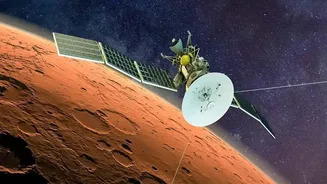
Hope spacecraft, the researchers meticulously mapped the climate across two of Mars's largest impact basins, Hellas and Argyre. Their work reveals a world of extreme temperature swings and complex atmospheric patterns, providing fresh clues about how the planet's weather works and how its massive landscapes shape its climate. This research isn't just an academic exercise; it provides a critical layer of data that corrects and refines existing climate models, making future predictions about Martian weather more accurate.
Understanding Martian Weather Extremes
The PRL team's findings paint a picture of a planet with a profoundly dynamic climate. Their data shows surface temperatures can swing dramatically, from a relatively mild 27°C in the summer to a bone-chilling -123°C in the winter. These enormous fluctuations are largely due to Mars's incredibly thin atmosphere—less than 1% the pressure of Earth's—which cannot effectively trap and distribute heat. Consequently, the surface heats up rapidly in sunlight and loses that heat just as quickly after sunset. The scientists also observed that this energy doesn't just radiate away; it moves in large-scale patterns called zonal waves. Think of them as ripples in the atmosphere, indicating how heat and air circulate globally, heavily influenced by the planet’s geography like deep basins and vast plains.
Why This Data is Critical for Landings
Landing a spacecraft on Mars is famously difficult, often referred to as the "seven minutes of terror." A craft enters the atmosphere at thousands of kilometres per hour and must autonomously shed all that speed to land safely. The planet's thin atmosphere is a double-edged sword: it's thick enough to cause significant heating from friction but too thin to slow a craft down sufficiently with parachutes alone. Sudden changes in atmospheric density, driven by the very temperature swings and waves mapped by the PRL scientists, can alter a lander's trajectory, making a precision landing incredibly challenging. A more accurate atmospheric map allows mission planners to better predict these conditions, improving the chances of a successful entry, descent, and landing.
Shaping the Design of Future Missions
Beyond just getting there, surviving on Mars is a monumental engineering challenge. The extreme temperature cycles place immense stress on robotic and, eventually, human-rated equipment. Rovers, habitats, and scientific instruments must be built to withstand daily temperature shifts of over 100 degrees Celsius. The PRL research provides engineers with a clearer picture of the thermal stresses their hardware will face, influencing everything from material selection to the design of heating and cooling systems. This data is invaluable not just for India's own future ambitions, which may include a lander, but for the entire global community of space agencies planning to send sophisticated rovers and even human explorers to the Red Planet.
India's Growing Role in Planetary Science
This detailed atmospheric mapping is the latest in a series of significant contributions by Indian scientists to our understanding of Mars. Building on the success of the Mars Orbiter Mission (Mangalyaan), which studied the Martian exosphere and the dynamics of dust storms for over seven years, India has solidified its position as a key player in planetary science. The work done at institutions like PRL demonstrates a sophisticated capability to analyze complex data and produce world-class research. As humanity collectively plans a future with a more permanent presence on Mars, it is fundamental science like this that will pave the way, ensuring that when we go, we go prepared.