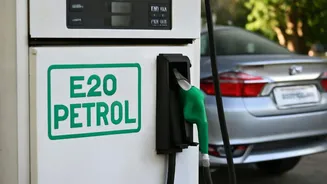






First, What Is E20 Petrol?
E20 petrol is a blend of 80% petrol and 20% ethanol. The Government of India has pushed for this blend as a nationwide standard for several key reasons: to reduce the country's expensive oil import bill, to lower vehicle emissions, and to create a domestic
market for ethanol, which is often produced from agricultural sources like sugarcane. This move is part of a broader strategy to adopt cleaner and more sustainable fuels. While E10 (10% ethanol) has been common for years, the shift to E20 marks a significant step up in the country's ethanol blending programme.
The Science Behind the Mileage Drop
The core reason for the drop in fuel efficiency lies in basic chemistry. Ethanol has a lower energy density, or calorific value, compared to pure petrol. This means that a litre of ethanol contains less energy than a litre of petrol. When you use E20 fuel, your car's engine has to burn slightly more of this blended fuel to produce the same amount of power needed to travel a certain distance. This increased fuel consumption is what results in lower mileage. Think of it like eating a less calorie-dense food; you might need to eat a bit more to get the same amount of energy. The effect isn't huge, but it is measurable.
Decoding the Official Numbers: 2-6% vs. 3-5%
The headline's ranges reflect findings from different official studies. Union Road Transport and Highways Minister Nitin Gadkari informed Parliament that E20 fuel can reduce vehicle efficiency by 2% to 6%, depending on the vehicle's age and type. This figure is based on a joint study by the Automotive Research Association of India (ARAI), the Society of Indian Automobile Manufacturers (SIAM), and Indian Oil Corporation Ltd (IOCL). Another government statement mentioned a drop of around 3-5% for some vehicles. Carmakers like Maruti Suzuki have reported an impact of about 3-3.5% based on their service data. These slight variations exist because mileage is affected by many factors, including engine type (turbocharged vs. naturally aspirated), vehicle calibration, driving conditions, and even tyre pressure. The key takeaway is that an official, modest drop in mileage is an expected outcome of using E20 fuel.
Is Your Vehicle Ready for E20?
This is a crucial question for many owners. Most vehicles manufactured after 2023 are designed to be fully E20-compatible. These modern engines and fuel systems use materials that can handle the higher ethanol blend without issues. For older cars, particularly those made before 2016, the picture is more complex. While the government and manufacturers state that extensive testing has shown no widespread engine failures, prolonged use of E20 in non-compliant cars can accelerate the wear of certain rubber and plastic components in the fuel system, like hoses and seals. However, for most vehicles, including many not originally certified for E20, the transition has been largely smooth, with no abnormal corrosion or component failures reported in mass service data.
The Real-World Impact on Your Budget
A small percentage drop in mileage might not sound like much, but what does it mean in rupees? Let's take a simple example. If your car typically delivers 15 km/l on E10 petrol, a 4% drop with E20 would reduce its mileage to about 14.4 km/l. Over a month of driving 1,000 kilometres, you would need approximately 69.4 litres of E20, compared to 66.7 litres of E10. At a price of ₹105 per litre, this translates to an extra fuel cost of around ₹280 per month. While not a dramatic increase, it's a tangible running cost that drivers will notice over the course of a year. The slightly lower per-litre cost of ethanol is often offset by the reduced mileage, meaning most users will see their overall monthly fuel expense remain similar or increase slightly.
Beyond Mileage: Other Trade-offs and Benefits
While the mileage debate gets the most attention, E20 offers other effects. On the plus side, ethanol is a higher-octane fuel, which can improve resistance to engine knocking and lead to smoother acceleration and better pickup. Studies have also confirmed that E20 reduces harmful emissions like carbon monoxide by around 30% compared to E10, making it a cleaner fuel for the environment. The main trade-off, aside from the mileage drop, is the potential for accelerated wear on some parts in older, non-compliant vehicles. For the vast majority of drivers with modern cars, however, the switch to E20 is a safe and validated change with clear environmental benefits.