

The Classic Story: A Slow-Motion Birth
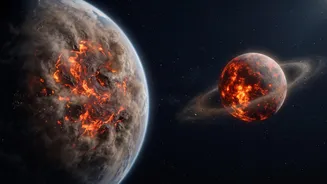
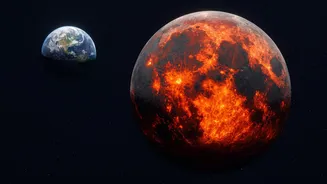
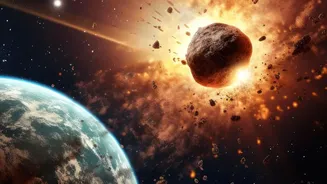
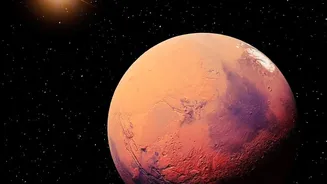
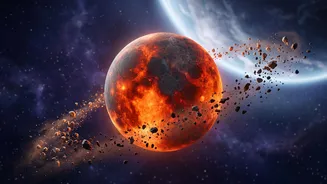
For many years, the most widely accepted explanation for the Moon's existence has been the "giant-impact hypothesis.". This theory proposes that about 4.5 billion years ago, when our solar system was young, a Mars-sized protoplanet named Theia slammed
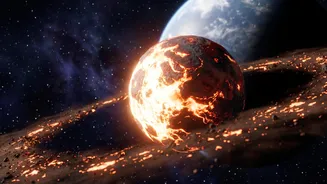
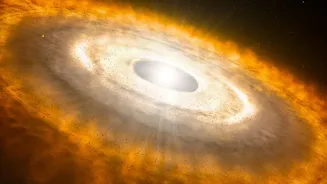
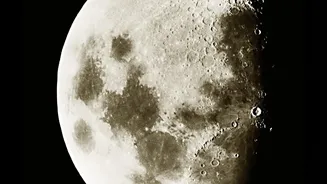
into the early Earth. The cataclysmic collision would have blasted a massive cloud of molten rock and debris into space. Over hundreds or thousands of years, this debris disc would have slowly coalesced, eventually clumping together to form the Moon we see today. This model successfully explained many things, including the Moon's relatively small iron core and why lunar rocks brought back by Apollo astronauts showed a composition strikingly similar to Earth's mantle.
A New, Faster Origin Story
Recent supercomputer simulations are challenging that long-held timeline. Researchers at NASA, Durham University, and the Southwest Research Institute have developed models that suggest a much more immediate and violent creation. According to this emerging scenario, the impact from Theia could have been so powerful that it didn't just create a debris ring; it launched a nearly fully-formed Moon directly into orbit. Instead of taking millennia to form, our satellite could have come together in as little as five hours. This isn't just a minor tweak to the old theory—it represents a fundamentally different way of thinking about how planetary bodies can be created.
What Makes the Difference?
The key factor in these new simulations is the introduction of more variables, particularly the material strength and temperature of the colliding bodies. Earlier models often treated the proto-Earth and Theia as fluids, assuming the sheer energy of the impact would make them behave as such. However, the new simulations, operating at much higher resolutions, considered that the planets might have been cooler and more solid. In scenarios where the colliding worlds were hotter and therefore weaker, the impact still produced a debris disk that formed a moon over time. But under certain conditions where the bodies were cooler and had more material strength, the simulations showed a large chunk of Theia surviving the initial impact and being thrown into a stable orbit, forming an intact satellite almost instantly.
Solving an Old Isotope Puzzle
One of the persistent challenges for the classic giant-impact model has been explaining just how similar the Earth and Moon are. The isotopic signatures of rocks from both bodies are nearly identical, suggesting they share a common origin. If the Moon formed mostly from the remnants of Theia, as older models suggested, it should have a different isotopic fingerprint. The rapid-formation model provides a potential solution. A more violent, direct impact would have caused a much more thorough mixing of material from both Earth's mantle and Theia, creating a new body with a blended, yet Earth-like, composition from the very beginning.
The All-Important Qualification: It’s a Simulation
This is the crucial caveat to keep in mind. The five-hour formation is a possibility raised by a computer model, not an observed fact. The outcome of the simulation depends entirely on the initial conditions plugged into it, such as the impact angle, the speed of the collision, and the temperature and composition of Theia and Earth. Since we can't know those exact conditions from 4.5 billion years ago, the five-hour timeline remains just one of several potential scenarios. It is a powerful and compelling one, but it is not yet proven. The model shows what is physically possible, but not necessarily what actually happened.
What's Next: The Hunt for Proof
To move from simulation to accepted theory, scientists need more physical evidence. The analysis of lunar rocks from the Apollo missions provided the foundation for the giant-impact hypothesis, and new samples could be what's needed to refine it. Future lunar missions, especially those that could collect rocks from the Moon's far side or its deeper mantle, will be critical. Scientists hope these samples will contain clues that could either support the rapid-formation model or point back toward the slower, disk-based accretion. Until then, we are left with two fascinating possibilities for our Moon’s birth: one a slow and steady process, the other a sudden and dramatic creation in a single, fiery afternoon.