

The Planet’s Tectonic Dance
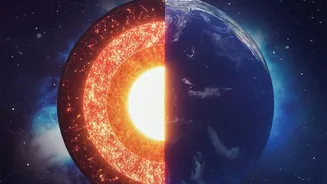
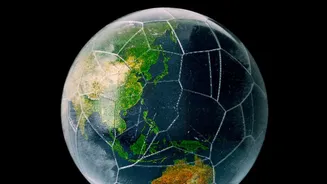
The secret to this colossal change lies deep beneath the waves in the science of plate tectonics. The Earth's crust isn't one solid piece; it's broken into massive slabs called tectonic plates that are in constant, slow motion. These plates float on the planet's
semi-fluid mantle, driven by immense heat from the Earth's core. This movement is incredibly slow, often just a few centimetres per year—about the same rate your fingernails grow. But over millions of years, this gradual drift is powerful enough to move continents, raise mountain ranges, and open and close entire oceans.
An Ocean in Retreat
The Pacific Ocean's shrinkage is a story of give and take. While new oceanic crust is created at underwater mountain ranges called mid-ocean ridges, old crust is simultaneously destroyed. The Pacific is bordered by a vast network of subduction zones, areas where the dense oceanic plate is forced to slide beneath a lighter continental plate and sinks back into the Earth's mantle. This process is like a giant planetary recycling system. Since the rate of destruction at these subduction zones is faster than the creation of new crust at its ridge, the Pacific basin is gradually contracting. This is in direct contrast to the Atlantic Ocean, which has fewer subduction zones and is currently expanding, pushing the Americas further west.
The Ring of Fire
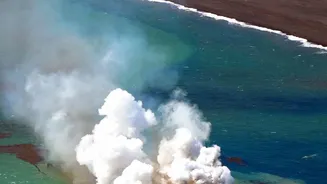
This ring of subduction zones around the Pacific is famously known as the Ring of Fire. Stretching about 40,000 kilometres in a horseshoe shape, this belt is home to roughly 75% of the world's volcanoes and experiences about 90% of its earthquakes. When an oceanic plate grinds its way underneath a continental plate, the immense friction and heat cause rock to melt. This molten rock, or magma, rises to the surface, creating the volcanic arcs and frequent seismic activity that define the region. So, the same process that is causing the Pacific Ocean to shrink is also responsible for some of the planet's most dramatic and powerful geological events.
A Glimpse into the Future
So what happens when an ocean shrinks? Geologists predict that this slow but relentless process will eventually lead to the formation of a new supercontinent. The last supercontinent, Pangaea, broke apart around 200 million years ago. Now, the continents are on a collision course once again. Using supercomputer simulations, scientists have forecast that in 200 to 300 million years, the Americas and Asia will merge as the Pacific Ocean closes completely. This future landmass has been dubbed Amasia, a combination of America and Asia. While there are other theories, like the formation of 'Pangaea Ultima' where the Atlantic closes, the shrinking of the Pacific makes the Amasia model a strong contender for how our planet's next chapter will unfold.