





The Arctic's Cloudy Puzzle
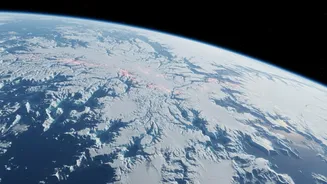
The Arctic is warming at least three times faster than the rest of the world, a phenomenon known as Arctic amplification. This rapid warming has profound consequences, from melting the Greenland ice sheet to altering global weather patterns. Central to understanding
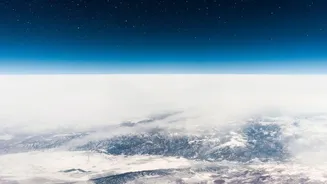
this trend are clouds. Clouds act as a complex climate regulator; they can cool the planet by reflecting sunlight back into space, or they can trap heat like a blanket, warming the surface below. In the pristine Arctic air, which has very few dust or pollution particles for water vapor to condense upon, cloud formation has been a long-standing scientific puzzle. Scientists have known that a loss of sea ice exposes the darker ocean, which absorbs more sunlight, but the precise relationship between melting ice and the clouds above has remained elusive.
A Breakthrough at the Ice's Edge
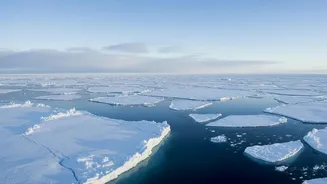
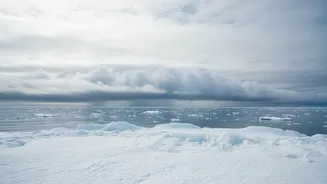
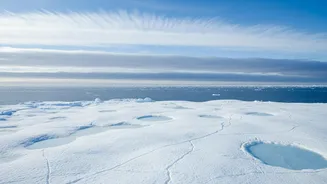
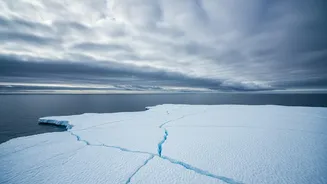
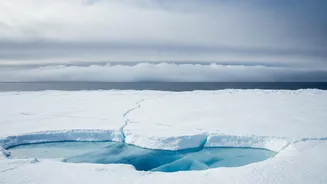
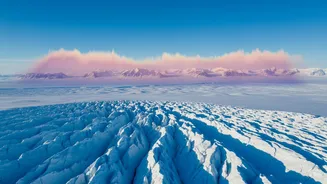
A recent study published in Nature Geoscience provides a breakthrough. An international team of scientists, led by the University of Birmingham, found direct evidence of a powerful new particle formation process occurring at the 'marginal ice zone'—the dynamic border where sea ice meets the open ocean. As the ice melts, this zone becomes a hotbed of biological activity. Marine algae thrive in the sunlit waters, and along with the sea itself, release a specific chemical cocktail into the atmosphere. Researchers on an expedition around Greenland observed that this mixture of iodine, sulphur, and other organic compounds, when hit by sunlight, triggers the creation of a massive number of new atmospheric particles.
The Birth of a Cloud Seed
These newly formed particles are essentially 'cloud seeds,' or cloud condensation nuclei. They provide the surfaces that water vapor needs to form droplets and, eventually, a cloud. The study's findings were dramatic: in one observed event, the concentration of these cloud-seeding particles jumped by 50 times in a single day, from approximately 50 to 1,500 particles per cubic centimetre. The research team also identified a new class of compounds, called iodine-containing oxygenated organic molecules (I-OOMs), which help these tiny new particles grow large enough to effectively seed clouds. This process, previously only demonstrated in lab experiments at CERN, has now been confirmed to be happening in the real world.
A Complicated Climate Feedback
The discovery reveals a complex feedback loop. A warming climate melts more sea ice, which exposes more of the marginal ice zone. This, in turn, creates more cloud-seeding particles, leading to more clouds. However, the ultimate effect of these extra clouds is not straightforward. More clouds during the sunlit summer could reflect sunlight and cool the open ocean, but they could also trap heat, potentially accelerating the melt of the remaining ice. As the marginal ice zone widens with continued climate change, this natural cloud-seeding process is expected to become more frequent and intense. Accurately representing this process in climate models is now a critical next step for scientists to refine projections of future Arctic and global climate.
Why the Arctic Matters for India
What happens in the Arctic does not stay in the Arctic. The rapid warming of the polar region has significant implications for the entire globe, including India. Changes in the Arctic can disrupt large-scale atmospheric circulation patterns like the jet stream, which can lead to more extreme weather events in the mid-latitudes, including shifts in temperature and precipitation. Furthermore, the single largest driver of global sea-level rise is the melting of land-based ice, particularly the Greenland ice sheet. For a country like India with a vast coastline of over 7,500 kilometers, rising sea levels pose a significant long-term threat to coastal communities, infrastructure, and freshwater resources. Understanding every mechanism that accelerates Arctic change is therefore crucial for preparing for future climate impacts.