





A Neighbor in Decline
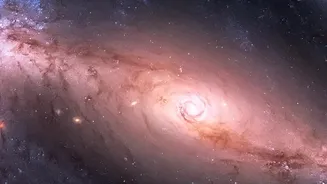
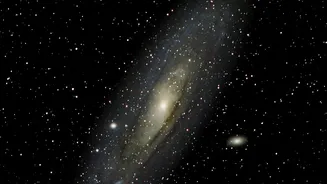
New data from Hubble confirms that star formation in Andromeda has been steadily decreasing for the last 500 million years, with the slowdown becoming even more pronounced in the last 40 million years. Astronomers measure this activity by the amount of
gas converted into stars annually. Around 500 million years ago, Andromeda produced stars at a rate of about one Sun's mass per year. Today, that rate has plummeted to just one-fifth of a solar mass per year. This isn't just a minor fluctuation; it's a fundamental shift in the life of the galaxy, signaling that it is entering a new, quieter phase of its evolution.
Reading the Galactic Fossil Record
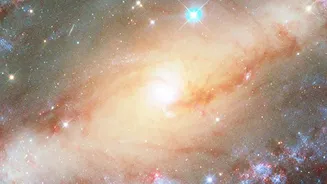
So how can astronomers see Andromeda's history? They use its stars as a 'fossil record'. By mapping the locations of roughly 200 million individual stars across two-thirds of the galaxy's disk, researchers can create a detailed timeline. Hubble’s powerful vision is crucial for this, as it can distinguish individual stars and their colors at a distance of 2.5 million light-years. Young, massive stars burn hot and appear blue, while older, less massive stars are redder and longer-lived. By analyzing the color of different regions, scientists can tell which areas have been recently active with star birth and which have been quiet for a long time.
The Fading Rings of Fire
The study revealed that much of the recent decline in star birth is concentrated in a prominent star-forming ring located about 32,000 light-years from the galaxy’s center. This ring, once ablaze with activity following a major burst of star formation about 2 billion years ago, is now fizzling out. Scientists believe this is a natural winding-down process. The galaxy isn't necessarily running out of the gas and dust needed to make stars, but is rather settling into a period of rest after a more energetic past, much like a marathon runner taking a breather. This process is known in astronomy as 'quenching'.
A Collision Course with a Culprit?
While the decline appears to be a natural part of Andromeda's lifecycle, a smaller companion galaxy may have played a role. Researchers suspect that a past interaction with the dwarf galaxy M32, which orbits Andromeda, may have influenced the slowdown. Data shows a notable decrease in star formation in the region of Andromeda's disk near M32, with the timing of the decline—starting roughly 60 million years ago—aligning with a potential close encounter. While it's difficult to prove definitively, M32 is considered a likely suspect for disrupting some of the stellar nurseries.
A Glimpse of Our Own Future?
Studying Andromeda's 'mid-life crisis' provides a unique window into how large spiral galaxies evolve. Our own Milky Way has had a more consistent, less dramatic history of star birth, currently producing stars at a higher rate than Andromeda. However, watching our neighbor's transition towards a quieter, 'quenched' state offers a preview of the eventual fate of many galaxies. Over billions of years, Andromeda will likely become a 'red and dead' galaxy, dominated by old, red stars, with very few new ones being born. This discovery gives astronomers a detailed case study of a process that shapes the cosmos.