


Laying the Foundation
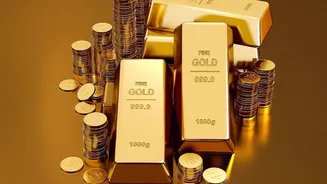
Before we look forward, we must understand our starting point. As of late 2026, the price of gold hovers at approximately ₹14,000 per gram. Therefore, a ₹50,000 investment would purchase about 3.57 grams of 24-carat gold. This is the base amount of physical
gold whose value we will be projecting over the next decade. This exercise is not about predicting a precise number but about understanding the potential outcomes based on historical performance. The key is to look at how gold has grown in the past to give us a framework for what it might do in the future. We will use a common financial metric, the Compound Annual Growth Rate (CAGR), to build these scenarios.
Scenario 1: The Conservative Outlook
Let's begin with a cautious and steady approach. Financial analysts often suggest that a sustainable long-term return for gold is the rate of inflation plus a few percentage points. Based on recent long-term analyses, a conservative CAGR for gold in India is around 8% per year. This figure smooths out the dramatic peaks and troughs, reflecting a more stable growth trajectory. Applying an 8% annual growth rate to our initial ₹50,000 investment for 10 years, the projected value in 2036 would be approximately ₹1,08,000. This scenario assumes that gold will continue its role as a reliable store of value that consistently beats inflation, but without the explosive growth seen in more volatile periods.
Scenario 2: The Moderate, History-Backed View
Our moderate scenario is rooted in gold's impressive performance over the last two decades. Looking at a 20-year timeframe helps to average out short-term market noise and provides a robust picture of long-term performance. Historical data from the mid-2000s to the mid-2020s shows that gold has delivered a Compound Annual Growth Rate (CAGR) of around 14% in Rupee terms. If this two-decade trend were to continue for the next 10 years, the outcome would be significantly different. Projecting our ₹50,000 investment with a 14% CAGR, its value in 2036 could reach approximately ₹1,85,000. This scenario reflects a belief that the underlying factors that have driven gold's strong performance over the last generation—including rising investor demand and its role as a hedge—will persist.
Scenario 3: The Optimistic Projection
For our optimistic case, we look at the performance of gold over the last 10 years. This period has been particularly strong for the yellow metal, influenced by significant global uncertainty, aggressive central bank buying, and robust investor interest. During this time, gold's CAGR has been in the region of 17%. Should these highly favourable conditions persist or re-emerge over the next decade, the growth could be substantial. Projecting the ₹50,000 investment forward at a 17% annual growth rate gives us a potential value of approximately ₹2,40,000 by 2036. This scenario represents a high-growth environment where gold's appeal as a safe-haven asset is maximised.
The X-Factors: What Could Change the Numbers?
These projections are simply mathematical exercises based on past data. The actual future value will be shaped by a complex mix of global and domestic factors. The value of the Indian Rupee against the US Dollar is a critical variable; a weaker Rupee makes imported gold more expensive, driving up local prices. Government policies, particularly import duties and Goods and Services Tax (GST), also play a significant role in the final price for consumers. Globally, inflation rates, interest rate decisions by central banks like the US Federal Reserve, and geopolitical instability are powerful drivers. Periods of high uncertainty often send investors flocking to gold, pushing its price up, while periods of economic stability and high interest rates can have the opposite effect. Finally, domestic demand, especially during festival and wedding seasons, provides a constant and unique floor for gold prices in India.