


A World Full of Surprises
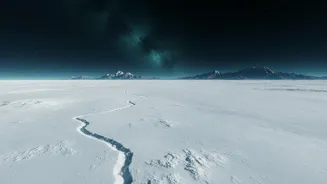
When NASA's New Horizons spacecraft flew past Pluto in 2015, it completely transformed our view of the dwarf planet. For decades, it was presumed to be a simple, inert, and frozen world, a relic from the early solar system. Instead, the images sent back
revealed a surprisingly complex and active surface, featuring towering mountains of water ice, vast plains, and a hazy atmosphere. The mission’s findings challenged long-held assumptions and showed that even at the frigid edges of our solar system, nearly six billion kilometres from the Sun, planetary processes can remain active. This discovery opened up a new chapter in planetary science, forcing researchers to reconsider what it means for a world to be geologically alive.
The Beating Heart of Pluto
At the centre of Pluto's transformation from a simple ice ball to a complex world is a massive, heart-shaped feature officially named Tombaugh Regio. The western lobe of this 'heart' is a vast basin called Sputnik Planitia. This plain, larger than Texas and Oklahoma combined, is filled not with water ice but with frozen nitrogen, methane, and carbon monoxide. Most strikingly, this vast expanse is almost completely devoid of impact craters, which pockmark most other ancient surfaces in the solar system. The lack of craters is a clear sign that the surface is young and is being constantly renewed, a process that points directly to ongoing geological activity.
Glaciers in Slow Motion
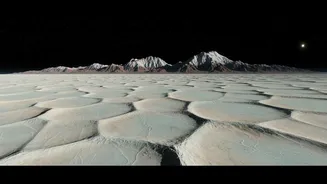
The evidence for activity within Sputnik Planitia is compelling. Images from New Horizons show the nitrogen ice is not a static sheet. Its surface is broken up into large, city-sized polygonal cells. Scientists believe these patterns are the result of slow-motion convection. Warmer, less dense nitrogen ice from the bottom of the basin slowly rises, spreads, and then cools and sinks back down, similar to the way wax circulates in a lava lamp. Furthermore, analysis reveals features that look like glaciers flowing out of the surrounding highlands and into the basin. More recent studies, announced in August 2026, provide the first evidence that liquid nitrogen may be rising from beneath the glacier through cracks and wetting the surface before refreezing, creating dark streaks similar to those seen on wet glaciers on Earth.
The Engine Driving the Activity
Such dynamic surface activity—convection and flowing nitrogen—cannot happen on a completely frozen world. It requires energy. Since Pluto is too far from the Sun for sunlight to be the primary driver, this points to an internal heat source. Scientists are exploring two main possibilities. The first is heat left over from Pluto's formation 4.5 billion years ago, which may be preserved by an insulating layer beneath the crust, potentially made of structures called clathrates. The second, more widely discussed theory is radiogenic heating, where the slow decay of radioactive elements like uranium, thorium, and potassium within Pluto's rocky core generates enough warmth to keep the interior surprisingly active. This internal heat is likely just enough to soften the nitrogen ice, allowing it to churn and flow, and may even create a vast subsurface ocean of liquid water.
Rewriting the Rules for Icy Worlds
The discovery of active geology on Pluto, driven by its internal heat and manifested in its flowing nitrogen, has profound implications. It proves that a planet doesn't need to be large or close to a star to have a complex and evolving surface. The evidence from New Horizons shows that even small, cold bodies at the edge of the solar system can retain enough internal heat to power geological processes for billions of years. This forces a complete rethink of the conditions required for a world to be considered 'active'. The lessons learned from Pluto's nitrogen flows provide a new framework for studying other icy bodies in the outer solar system, such as Neptune's moon Triton, and in planetary systems beyond our own.