




A Digital Look Inside a Lost World
The dodo, a flightless bird endemic to the island of Mauritius, disappeared in the 17th century, less than 100 years after it was first documented by sailors. Since then, it has been unfairly caricatured as a clumsy, witless creature that practically
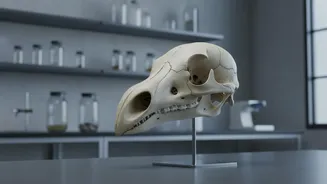
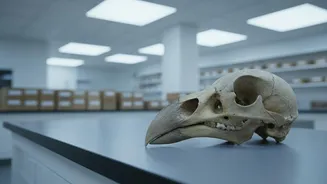
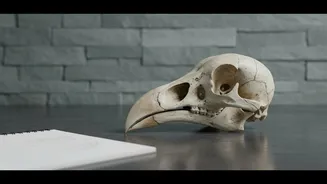
walked into extinction. This image was largely based on its apparent lack of fear towards humans, a trait common in isolated island species with no natural predators. With extremely few skeletons and only two known complete skulls in the world, scientists had little to work with to challenge this myth. That is, until now. Using high-resolution computed tomography (CT) scanners, researchers have digitally peered inside these priceless skulls, reconstructing the brain cavity to understand what the dodo's brain was actually like. This non-destructive technique allows scientists to study the imprints the brain left on the bone, offering unprecedented clues into how the dodo sensed and experienced its world.
Challenging the 'Dumb Bird' Myth
One of the most significant revelations from the scans is that the dodo was likely not 'dumb' at all. Researchers found that the dodo's brain-to-body size ratio was comparable to that of its closest living relatives, pigeons. Pigeons are known for their navigational skills and are considered moderately intelligent birds, capable of being trained. The study revealed no meaningful difference in the relative size of the forebrain, the region associated with cognition and learning, between dodos and modern pigeons. This directly challenges the centuries-old narrative that the dodo was unintelligent. Its fatal tameness was likely a result of evolving in a predator-free paradise, not a lack of cognitive ability.
A World Led by Scent and Touch
While its overall intelligence may have been average, the dodo's sensory world was anything but. The scans revealed an unexpectedly large olfactory bulb, the part of the brain that processes smell. For birds, which typically rely heavily on vision, this is a highly unusual trait. The dodo's sense of smell may have been far more developed than that of modern pigeons, possibly used to locate ripe fruit and other food sources on the forest floor. Furthermore, analysis of the trigeminal nerve, which transmits sensory information from the face, suggests the dodo’s large upper beak was a highly sensitive tool. It likely used its beak to gather tactile information from its environment, much like a kiwi does today. This combination of a strong sense of smell and a sensitive beak paints a picture of a creature well-adapted to foraging in its unique island habitat.
Life in the Low Light
Perhaps most surprising was what the scans suggested about the dodo's vision and daily habits. The optic lobes, the brain regions that process visual information, were found to be unusually small for a bird of its size. This anatomical feature is often seen in nocturnal or crepuscular (active at dawn and dusk) birds like owls and the kakapo. This has led researchers to propose that the dodo may not have been strictly active during the day. By being active in lower light conditions, the dodo could have avoided competing for food with other fruit-eaters on Mauritius, such as giant tortoises, which are most active during the day. Rather than having poor vision, the dodo’s eyes may have been adapted for detecting movement in low light, compensating with its other powerful senses.