


Understanding HEPA Technology
At the heart of most effective air purifiers is a HEPA filter. HEPA stands for High-Efficiency Particulate Air. It's a standard for mechanical air filters, defined as being able to theoretically remove at least 99.97% of airborne particles with a size
of 0.3 microns. These particles are invisible to the naked eye and include many common household irritants. A HEPA filter works like an incredibly fine, dense net made of pleated fibres. As the purifier draws air through this filter, it physically traps particles like dust, pollen, mould spores, and even some bacteria. This mechanical process is crucial—it captures pollutants instead of just moving them around.
The Battle Against Airborne Dust
So, how effective are they against dust? Very. Air purifiers equipped with true HEPA filters are considered the gold standard for reducing airborne dust. The fine dust you see floating in a sunbeam is precisely what these machines are designed to capture before it has a chance to settle. This includes not just inert particles but also common allergens mixed in with household dust, such as dead skin cells, pet dander, and dust mite debris. By continuously cycling the air in a room, a purifier can significantly lower the concentration of these airborne particles. One study even found that indoor PM2.5 concentrations, a category of fine particles that includes dust, were reduced by over 50% with the use of HEPA filters.
Finding the 'Right Room' and Size
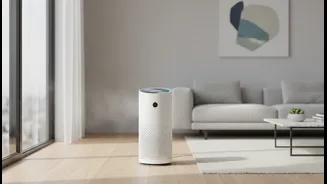
The phrase "in the right room" is critical. The effectiveness of an air purifier is directly tied to its capacity and the size of the space it's in. This is measured by the Clean Air Delivery Rate (CADR). CADR indicates how quickly the purifier can clean the air within a particular room size. Manufacturers will list a recommended room size for their units, but it's important to match this to your needs. An undersized unit will struggle to clean the air effectively, running on high speed constantly without making much of a difference. As a general rule, you should choose a purifier with a CADR rating that is at least two-thirds of your room's area in square feet. For optimal performance, especially for those with allergies, the goal is to have the purifier filter all the air in the room about four to five times per hour.
What Air Cleaners Can't Do
It's equally important to understand the limitations of HEPA purifiers. They are designed to capture airborne particles only. They cannot remove dust that has already settled on your bookshelves, tables, and floors. Regular cleaning and dusting are still essential. Furthermore, standard HEPA filters do not remove gases, odours, or volatile organic compounds (VOCs) that can be released from paints, cleaning products, and new furniture. For that, you would need a purifier that also includes an activated carbon filter, which is designed to adsorb these gaseous pollutants. Think of a HEPA filter as a particle specialist, not an all-in-one air quality solution.
Making the Most of Your Purifier
To get the best results, you can't just plug in an air purifier and forget it. For it to work properly, the room should be a closed environment, so keep windows and doors shut while it's running. Air purifiers are most effective when they run continuously, as dust and pollutants are generated all day. Placement also matters; avoid pushing it into a corner or behind furniture where airflow is blocked. Finally, maintenance is key. The filters will get clogged with the pollutants they capture. Check and replace your filters according to the manufacturer's recommendations. A dirty filter can't do its job and may even lead to the growth of mould or bacteria.