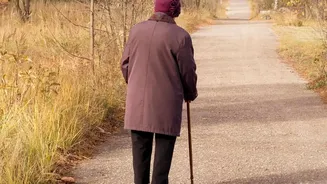









It’s a familiar headline: a simple habit linked to a longer life. The latest involves walking speed. A new study suggests a brisk pace is associated with longevity, but scientists are careful to point out this isn't definitive proof.
What the New Study Suggests
Recent research has
added an interesting layer to our understanding of daily movement and health. A large observational study tracked thousands of adults, monitoring not just how many steps they took, but also how fast they walked during their most active periods of the day. The findings showed a compelling link: individuals with a faster average walking pace had a lower risk of dying from all causes, including cardiovascular disease, compared to their slower-walking counterparts. This link held true even when researchers accounted for the total amount of time people spent walking, suggesting that the intensity of the walk might offer its own unique benefits.
Association vs. Causation: A Key Distinction
This is where the headline's caution becomes critical. The study demonstrates an 'association,' which is not the same as 'causation' or proof. An association simply means two things are observed happening together. For example, people who walk faster tend to live longer. However, this does not prove that walking faster is the direct cause of their extended lifespan. It is also possible that people who are healthier to begin with—perhaps due to better genetics, diet, or other lifestyle factors—are naturally able to walk at a brisker pace. The study itself does not determine which direction the effect goes, only that the connection exists.
Why Might Faster Walkers Live Longer?
Even without proving causation, there are strong theories as to why a quicker pace could be beneficial. Walking at a higher intensity places greater demand on your heart and lungs. This acts as a workout for your cardiovascular system, improving its efficiency over time. A faster pace can help maintain a healthy weight, strengthen bones and muscles, and improve balance and coordination, all of which contribute to overall health and resilience against age-related decline. Some experts refer to gait speed as a 'sixth vital sign' in older adults because it can be a reliable indicator of underlying health, reflecting everything from heart function to muscle strength.
What This Means For Your Daily Walk
So, should you dismiss the findings? Not at all. While the study isn't a prescription, its message is practical and empowering. The strong association suggests that incorporating more intensity into your walks is a low-risk, potentially high-reward strategy for improving your health. You don't need special equipment or a gym membership. The takeaway is not to fixate on a magic number, but to consider the quality of your movement. If you have limited time, focusing on picking up the pace during your regular walks could be a very effective way to make those minutes count.
A Holistic View on a Healthy Life
It's important to place this single habit into the broader context of a healthy lifestyle. Walking, at any speed, is just one component. The benefits are magnified when combined with a balanced diet, adequate sleep, stress management, and regular social engagement. This study doesn't suggest that fast walking can erase the effects of poor health habits elsewhere. Rather, it reinforces a fundamental principle of well-being: purposeful physical activity is a cornerstone of a long and healthy life. The simple act of putting a little more energy into your step is a positive and accessible change anyone can make.