

A Cosmic Puzzle
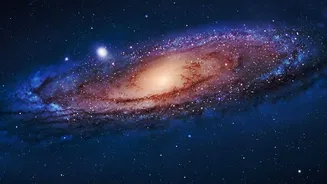
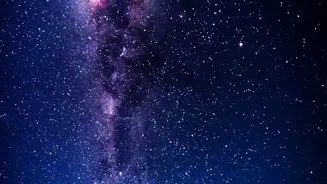
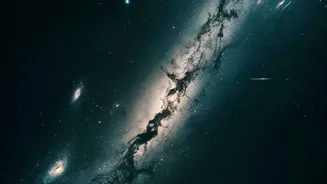
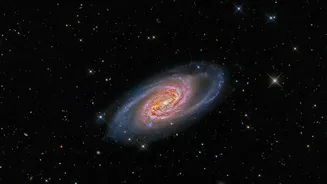
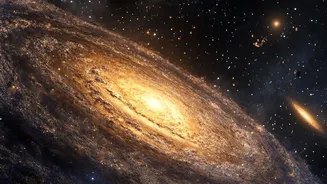
When you picture the Milky Way, you probably imagine a flat, spinning disc of stars. But that's only part of the story. Surrounding this disc is a vast, sparse cloud of ancient stars called the stellar halo. For years, astronomers were puzzled by this halo;
observations showed it was rotating far more slowly than the main disc. This discrepancy suggested something dramatic happened in our galaxy's youth. More recent studies revealed the halo isn't a neat sphere but is tilted and shaped more like a football or zeppelin, further deepening the mystery of our galaxy's structure.
The Prime Suspect: A Galactic Crash
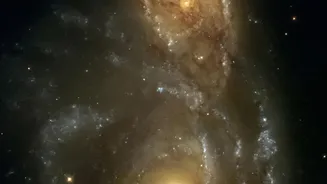
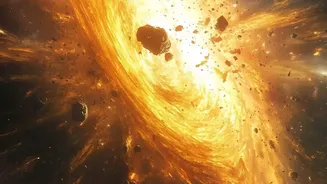
To solve this puzzle, astronomers at Durham University used powerful supercomputer simulations. They found that when galaxies similar to the Milky Way undergo a massive, head-on collision, two things often happen: their stellar halos end up rotating very slowly, and the entire galactic disc can flip on its side. The culprit in our case appears to be a dwarf galaxy nicknamed Gaia-Sausage-Enceladus. This galaxy, named after the Gaia space telescope that helped discover it and its sausage-shaped debris field, slammed into a young Milky Way roughly 10 billion years ago.
Recreating A 10-Billion-Year-Old Event
A galactic 'collision' isn't like a car crash. Because stars are so far apart, they rarely hit each other directly. Instead, the immense gravitational forces of the two merging galaxies do the damage. As Gaia-Sausage plunged through the Milky Way, it was torn to shreds, its stars scattered throughout what would become our galaxy's halo. According to new simulations presented in July 2026, the gravitational torque from this violent merger was likely strong enough to slowly reorient the entire Milky Way. The 'flip' wasn't instantaneous; it would have been a gradual process taking hundreds of millions or even a billion years.
Clues Written in the Stars
This theory of a galactic flip neatly explains the mysteries of the stellar halo. The slow rotation is a direct consequence of the head-on nature of the merger. And the tilted, oblong shape of the halo is the fossil record of the shredded Gaia-Sausage galaxy. This event was the most significant merger in our galaxy's history, profoundly reshaping it. While the Gaia-Sausage event is the leading candidate for causing the flip, our galaxy's history is full of collisions. Another, more recent event called the Virgo Radial Merger happened less than 3 billion years ago, leaving its own shell-like scars on the galaxy. These multiple collisions paint a picture of a dynamic and chaotic past.
Why This Changes Our View of Home
Understanding this ancient history isn't just an academic exercise; it changes how we see our place in the cosmos. It means that the stable galactic plane we inhabit today is likely oriented very differently than it was billions of years ago. Even our own Sun may have once traveled along a completely different path through the galaxy before the disc settled into its current position. By studying the aftermath of these collisions, astronomers can reconstruct the complex story of how large galaxies like ours are built over time, one cosmic crash at a time.