


Meet NASA's Newest Sky-Mapper
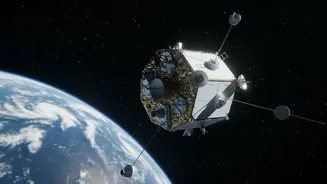
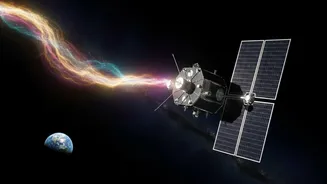
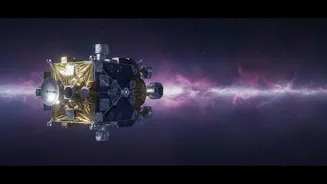
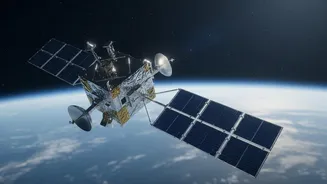
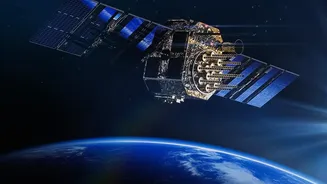
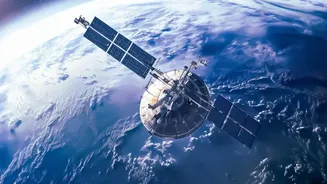
The mission at the heart of this new data dump is NASA's Interstellar Mapping and Acceleration Probe, or IMAP for short. Launched in September 2025, IMAP is a state-of-the-art observatory with a singular purpose: to explore the boundary of our solar system.
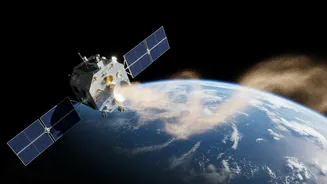
It’s a celestial cartographer, charting the invisible bubble created by the Sun's solar wind, known as the heliosphere. This bubble acts as a protective shield, deflecting harsh radiation from interstellar space. To get the best view, the spacecraft is positioned at a unique spot one million miles from Earth toward the Sun, a gravitationally stable location called the first Lagrange point (L1). From this vantage point, it can observe the solar wind before it reaches our planet.
Understanding the Solar Wind
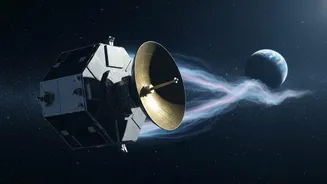
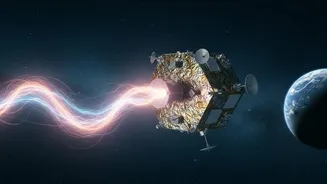
To appreciate what IMAP is studying, it’s important to understand that the solar wind isn't a gentle breeze. It's a relentless, high-speed stream of plasma—superheated gas made of charged particles like electrons and protons—that flows outward from the Sun in every direction. This wind can travel at astonishing speeds, ranging from 400 to 800 kilometers per second. It carries with it the Sun's magnetic field, shaping the environment of the entire solar system. This constant outflow is what inflates the heliosphere, creating a buffer between the planets and the rest of the galaxy.
Why This Cosmic Wind Matters
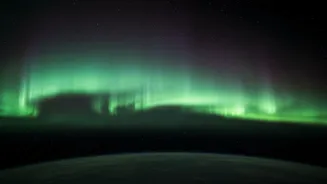
While it happens millions of miles away, the solar wind has tangible effects on Earth. When its charged particles interact with our planet's magnetic field and atmosphere, they create the stunning auroras, the Northern and Southern Lights. But there's a more volatile side. Intense bursts from the Sun, like coronal mass ejections, can supercharge the solar wind, triggering geomagnetic storms. These storms have the potential to disrupt our modern way of life, threatening everything from communications satellites and GPS navigation to power grids on the ground. Understanding and predicting this 'space weather' is critical for protecting our technology and ensuring the safety of astronauts.
The First Flood of Information
On August 7, 2026, NASA and Princeton University, which leads the mission, made the first major set of science data from IMAP publicly available. This initial release, covering observations collected through April of this year, comes from seven of the probe's ten sophisticated instruments. This isn’t just a trickle of information; it’s a coordinated deluge. The data includes measurements of solar wind ions and electrons, the interplanetary magnetic field, and even interstellar dust particles that have managed to pierce our heliosphere. Some of this information is already being fed in near real-time to space weather forecasters through a system called I-ALiRT (IMAP Active Link for Real-Time).
A Sharper, More Dynamic View
So, what are the “fresh clues” this data provides? For now, the biggest clue is the data itself. IMAP is providing the most comprehensive and coordinated measurements ever taken of the solar wind. Instead of seeing one part of the puzzle, scientists can now see multiple aspects simultaneously. Early results have already shown the mission's value; one instrument, the Solar Wind Electron (SWE) experiment, successfully measured an intense solar flare while other instruments went into safe mode, proving its resilient design. Another instrument is already building the first-ever all-sky map of particles arriving from the very edge of the solar system. This new level of detail is the first step toward developing a new, more complete understanding of how the Sun influences its cosmic neighborhood.
Pioneering the Future of Space Weather
This data release is just the beginning of IMAP's two-year primary mission, which officially began on February 1, 2026. As the mission continues, it will build dynamic maps that show how the heliosphere 'breathes' in response to the Sun's activity. This will be transformative for space weather prediction. By providing a continuous stream of high-quality data from its strategic location, IMAP will help forecasters issue more accurate and timely warnings for potentially harmful solar events. These insights will be invaluable for protecting our increasingly space-dependent society and for planning future crewed missions to the Moon and beyond, where astronauts will be far more exposed to the solar wind's effects.