




More Than Just a Pretty Shape
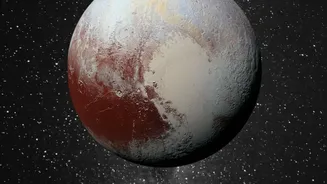
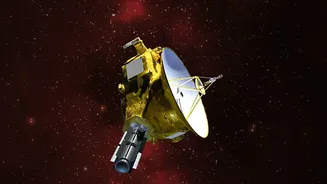
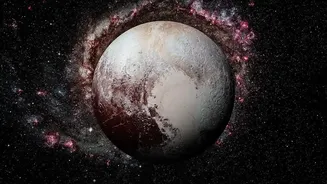
Before 2015, most scientists expected Pluto to be a cold, dead, and heavily cratered ball of ice. But the images from New Horizons revealed something entirely different: a world with breathtaking mountains of water ice, vast plains, and, most surprisingly,
a bright, heart-shaped feature named Tombaugh Regio. The western lobe of this heart, a smooth, sprawling basin called Sputnik Planitia, immediately caught scientists' attention. Spanning over a million square kilometres, this plain was strikingly devoid of the impact craters that pockmark most other old surfaces in the solar system. This lack of craters was the first major hint that we had fundamentally misunderstood Pluto. It wasn't an inert relic; it was a world being actively reshaped from within.
A 'Beating' Heart of Ice
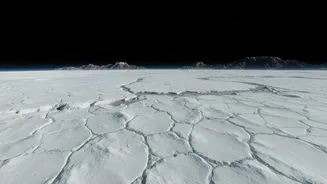
Sputnik Planitia is not made of water ice like a glacier on Earth. Instead, it’s a deep basin filled with a mixture of exotic frozen gases, primarily nitrogen, with traces of methane and carbon monoxide. The surface is covered in a bizarre pattern of giant polygons, typically 20 to 40 kilometres across. Scientists quickly realised these were the signs of slow-motion convection. Think of a lava lamp or a pot of simmering oatmeal: warmer material at the bottom rises, cools at the top, and then sinks back down. In Sputnik Planitia, modest heat from Pluto's interior gently warms the bottom of the nitrogen ice sheet. This warmer, slightly less dense ice rises to the surface in the center of the polygons, then spreads out, cools, and sinks along the edges. This constant, slow churning works to erase any impact craters, keeping the surface looking perpetually young.
An Engine Running on Fumes
What powers this activity on a world nearly 6 billion kilometres from the Sun? It’s a question that has sparked considerable scientific creativity. Pluto is too small to have retained much of the intense heat from its formation 4.5 billion years ago. The leading theory is that the engine is powered by a very modest amount of internal heat, likely from the slow decay of radioactive elements within Pluto's rocky core. This faint warmth is all that's needed because nitrogen ice is incredibly soft at Pluto's frigid surface temperatures of around minus 235 degrees Celsius. It doesn't take much energy to get it to flow. Some models even suggest a layer of trapped gas or a subsurface ocean could be acting as insulation, helping Pluto hold onto its limited heat budget for billions of years.
A Youthful Complexion and Leaky Plumbing
The churning surface of Sputnik Planitia is estimated to be no more than 10 million years old, and in some spots, much younger. This is a geological infant compared to the neighbouring cratered highlands, which are billions of years old. The constant renewal means any crater that forms is essentially paved over in a relatively short amount of time. More recent analysis of the New Horizons data has added another twist to the story. Patterns of dark streaks along the margins of the convection cells look remarkably similar to areas on Earth's glaciers wetted by meltwater. Computer models suggest that nitrogen ice at the very bottom of the glacier can melt under pressure, creating pockets of liquid nitrogen. This liquid may then be forced up through cracks, briefly flowing before freezing again on the surface. Pluto's heart, it seems, may be leaking.
Redefining What a 'World' Can Be
The discovery of an active Pluto has revolutionised how we think about the outer solar system. It proved that small, distant worlds can be geologically complex and dynamic. It's not just about size or proximity to the Sun; the specific materials a world is made of matter immensely. The unique properties of nitrogen ice allow Pluto to have active geology powered by a heat source that would be far too weak to move rock or even water ice. The lessons learned from Pluto's surprising heart are now being applied to other distant bodies, like Neptune's moon Triton, which also shows signs of geological activity. Pluto has shown us that even in the coldest, darkest corners of our solar system, there are vibrant and active worlds waiting to be discovered.