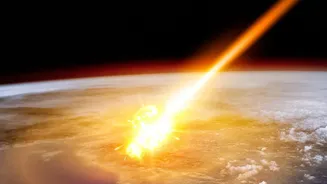



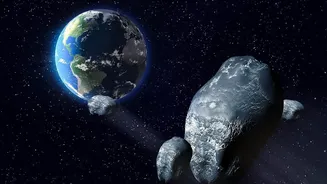
The idea of stopping a 'doomsday' asteroid often brings to mind a single, massive explosion. But scientists at Sandia National Laboratories have found it’s far more complex, revealing that precision may be more important than pure power.
Beyond Spheres and Speculation
For years, planning
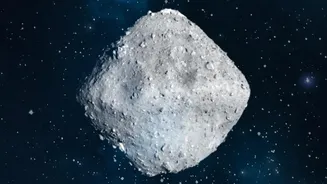
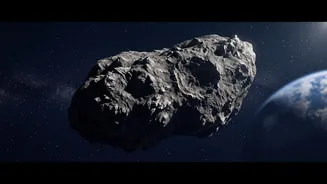
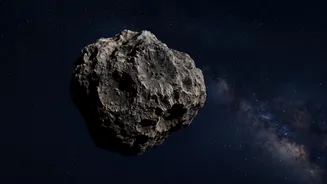
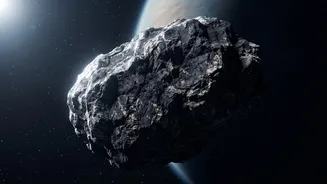
for planetary defense involved a significant simplification: modeling asteroids as perfect spheres. This made the incredibly complex calculations manageable, but as Sandia physicist Nathan Moore noted, spherical asteroids don't actually exist in space. Real-world asteroids are lumpy, irregular, and unpredictable. A groundbreaking new study published in the journal Icarus moves beyond these simplifications. Using a new, high-fidelity computer model that is over 1,600 times faster than previous methods, researchers can now incorporate the realistic, asymmetrical shapes of actual asteroids captured by spacecraft flybys. This allows for a much more detailed look at what might happen if we ever need to nudge one off a collision course with Earth.
The Fivefold Difference
The study's most startling finding is just how much an asteroid's shape influences the outcome of a deflection attempt. The concept involves detonating a nuclear device at a standoff distance, bathing one side of the asteroid in intense X-rays. This instantly vaporizes surface material, creating a powerful push, like a rocket engine, to alter its trajectory. The simulations showed that targeting different sides of the same lumpy, potato-shaped asteroid could produce wildly different results. In one case, a simulated X-ray blast from one angle produced a change in velocity of 3.9 millimeters per second. When aimed at a different side of the exact same asteroid, the velocity change was just 0.8 millimeters per second — a nearly fivefold difference in effectiveness. As Moore stated, 'We expected aim to matter. What surprised us was how much.'
It's Not Just Push, It's Spin
The deflection force isn't the only variable. An off-center push on an irregular object can also send it spinning, and the simulations revealed this effect can be even more dramatic. For one simulated asteroid, the change in its rotational speed varied by a factor of 17 depending on where the blast was aimed. This is a critical factor for planetary defense planners. An asteroid sent into a rapid, uncontrolled tumble could make follow-up missions or further observation much more difficult. The goal is to gently push the asteroid onto a safe path, not send it careening unpredictably through space or, even worse, shatter it into multiple hazardous fragments. The new model helps calculate this by creating a heat map of the surface to show how the push and spin will be applied.
From Digital Models to Real_World Defense
This research builds on earlier experiments at Sandia's Z machine, the world's most powerful X_ray generator, which confirmed that X_ray bursts could indeed push mock asteroid material. While these new findings are still based on simulations, they represent a vital step in developing a credible defense strategy. It underscores the critical need for better reconnaissance. Before attempting to deflect an asteroid, we would need detailed, 3D models of its shape to determine the optimal point of impact. This work complements other planetary defense research, like NASA's DART mission, which successfully demonstrated a 'kinetic impact' by crashing a spacecraft into an asteroid. While DART proved we can hit a target, Sandia's work is refining what to do when a much larger energy source, like a nuclear device, is required for a much larger threat.