







A Landmark Orbital Flight
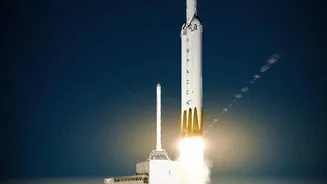
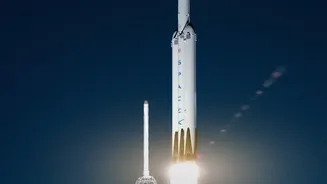
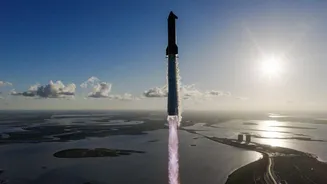
On Monday, September 28, the world's largest and most powerful rocket, Starship, lifted off from its Starbase facility in Texas. This fourteenth test flight marked a significant moment: for the first time, the vehicle successfully achieved a sustained
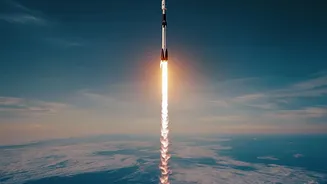
Earth orbit. The flight was not without drama; an engine on the upper stage shut down prematurely, forcing a tense, in-flight decision to proceed with the orbital insertion burn. Despite the anomaly, mission control pushed forward, and Starship successfully nudged itself into orbit at an altitude of approximately 275 kilometres. The mission also achieved another first by deploying 26 operational Starlink satellites, transitioning Starship from a pure test vehicle to an operational spacecraft. While the original plan called for a nearly 10-hour mission with six orbits, SpaceX opted to bring the vehicle back early out of caution, completing a successful splashdown in the Pacific Ocean after about three hours.
Why 275 Kilometres Matters
Reaching an altitude of 275 kilometres is far more than just a number. It represents crossing the threshold from brief suborbital hops into true orbital flight, a much more complex and demanding achievement. Operating in orbit requires moving at incredible speeds—around 28,000 km/h—to continuously 'fall' around the planet. This successful orbital insertion demonstrates that Starship can perform the manoeuvres needed to operate as a true spacecraft. It also allowed SpaceX to test critical systems over a longer duration and under the harsh conditions of space. Furthermore, the mission involved a controlled deorbit burn and atmospheric reentry, providing invaluable data on how the vehicle's heat shield and flight surfaces handle the intense heat and pressure of returning to Earth. This successful trip to orbit and back is a critical validation of the rocket's design and a necessary step before it can be trusted with more valuable cargo, and eventually, human passengers.
The Holy Grail: Full Reusability
As significant as reaching orbit is, for SpaceX, it's a means to an end. The ultimate goal, the one that underpins the entire Starship program, is full and rapid reusability. For decades, rockets have been expensive, single-use machines. The main body of the rocket is discarded after every launch. SpaceX partially changed this with its Falcon 9, which can land and refly its first-stage booster. Starship aims to take this concept to its logical conclusion. The system is designed for both its massive Super Heavy booster and the Starship upper stage to return to the launch pad, be caught by mechanical arms, refuelled, and launched again in a matter of hours. Achieving this would fundamentally change the economics of space access, much like how reusable aircraft revolutionised air travel. By eliminating the need to build a new rocket for every single mission, the cost of sending cargo and people to orbit could plummet, making ambitious projects far more feasible.
Paving the Way to the Moon and Mars
This successful orbital flight directly feeds into SpaceX's long-term vision of making humanity a multi-planetary species. Starship is not just a satellite launcher; it is the vehicle NASA has selected to land its Artemis astronauts on the Moon. Before it can perform that lunar landing, it must prove its reliability and reusability in Earth orbit. Future test flights will need to demonstrate even more complex manoeuvres, such as in-space refuelling, where a tanker Starship tops up another's propellant tanks in orbit for long-duration voyages. This capability is essential for missions to the Moon and, eventually, Mars. Each successful test, from reaching a new altitude to deploying a payload, is a building block in that grander architecture. The recent flight, while shortened, represents a major leap from development into operational reality, keeping SpaceX on track for its lunar and interplanetary ambitions.