






An Eye in the Martian Sky
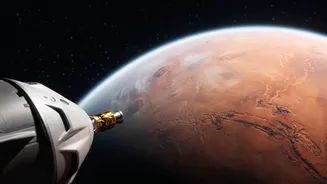
The key to this new understanding is the Emirates Mars Mission, also known as the 'Hope' probe. It is the Arab world’s first interplanetary mission and a testament to global scientific collaboration. Launched in 2020, the Hope spacecraft entered Mars'
orbit in 2021 with a unique objective: to build the first complete picture of the Martian atmosphere throughout the day and across all seasons. Its high, elliptical orbit allows its instruments to observe the planet in a way many previous missions could not, capturing a global snapshot of atmospheric phenomena over time. One of its key instruments is the Emirates Mars Infrared Spectrometer (EMIRS), which measures infrared radiation. It is this data that scientists at the Physical Research Laboratory (PRL) in Ahmedabad have meticulously analysed to uncover new details about the Red Planet's climate. This effort showcases India's growing prominence in planetary science, building on the legacy of its own successful Mars Orbiter Mission, Mangalyaan.
A Planet of Extremes
The PRL team’s research, published in the journal Current Science, confirms just how extreme the Martian environment is. Their analysis revealed staggering temperature fluctuations, with the surface swinging from a relatively mild 27 degrees Celsius in the summer to a bone-chilling -123 degrees Celsius. This dramatic range is largely due to Mars' incredibly thin atmosphere, which is about 100 times less dense than Earth's. Without a thick atmospheric blanket to trap and circulate heat, the Martian surface warms up rapidly under the sun and loses that heat just as quickly when night falls. The planet's orbit adds another layer of complexity. Mars follows a much more elliptical path around the Sun than Earth does. It reaches its closest point to the Sun during its southern hemisphere's summer, making that season significantly more intense, with temperatures in some areas about 25 degrees higher than in the northern summer.
Riding the Atmospheric Waves
Perhaps the most fascinating discovery is not just the temperatures themselves, but how they move. The scientists found that temperatures don't just rise and fall with the day-night cycle and seasons; they also form large-scale patterns that ripple across the planet. These are known as zonal waves, and they act as an indirect window into the planet’s atmospheric circulation, much like watching ripples on a pond can tell you about unseen currents below the surface. The researchers focused on two of Mars' largest impact basins, Hellas and Argyre, and found that the planet's topography plays a huge role in shaping these waves. The Argyre basin was dominated by a large, simple wave pattern, while the deeper Hellas basin showed more complex and varied wave patterns that changed with the seasons. This confirms that Mars' giant craters and vast plains are not just static features but are active drivers of its global weather systems.
Why Understanding Martian Weather Matters
Mapping these temperature patterns and waves is more than just a cosmic weather report. This detailed understanding of Mars' atmospheric dynamics is critical for the success of future missions. Knowing the weather—from intense temperature drops to atmospheric waves—is vital for the safe landing and operation of rovers and, eventually, human habitats. Furthermore, studying how Mars' thin atmosphere transports heat helps scientists build better climate models. By understanding the processes on a planet that lost its thick atmosphere and liquid water, we can gain valuable insights into the forces that govern planetary climates, including our own. This research, a shining example of Indian scientific prowess leveraging international data, helps piece together the puzzle of Mars' past, present, and future. It's a crucial step in our quest to understand our planetary neighbour and our place in the cosmos.