





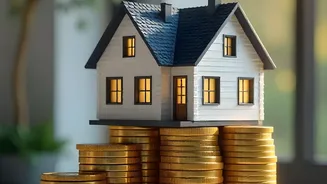
A Look at Gold's Past Performance
Predicting the future is impossible, but history offers valuable clues. Over the last two decades, gold has been a reliable performer for Indian investors. Looking at the period from the mid-2000s to today, the precious metal has generated a Compound
Annual Growth Rate (CAGR) of around 11% to 14% in Rupee terms. This means that, on average, its value increased by that percentage each year. This growth wasn't a straight line; it happened in spurts, often driven by global economic events. For example, the 2008 financial crisis and the economic uncertainty of the 2020s saw investors flock to gold as a safe-haven asset, pushing prices up significantly. While past performance is no guarantee of future results, these historical returns provide a realistic baseline for what long-term investors might expect.
What Drives the Price of Gold?
The price of gold isn't random; it's influenced by a complex mix of global and domestic factors. One of the most significant is the USD-INR exchange rate. Since gold is traded internationally in US dollars, a weaker Rupee means it costs more to import gold, driving up local prices even if the international price is flat. Inflation is another key driver; as the purchasing power of currency decreases, investors often buy gold to preserve the value of their wealth. Furthermore, global events play a huge role. Geopolitical instability, like wars or trade tensions, creates uncertainty, prompting central banks and individual investors to buy gold for security. Finally, domestic demand, especially during India's festive and wedding seasons, provides a consistent floor for prices. All these factors will continue to shape gold's journey towards 2036.
Three Hypothetical Scenarios for 2036
So, what could that Rs 50,000 become in ten years? While we can't give a single number, we can model a few scenarios based on historical growth rates. These are purely for illustration: 1. A Conservative Growth Scenario (8% CAGR): If gold's growth slows down to an average of 8% per year, your Rs 50,000 investment would grow to approximately Rs 1,08,000 by 2036. 2. A Moderate Growth Scenario (11% CAGR): This is in line with the average return over the past decade. At this rate, your investment would be worth around Rs 1,42,000 in ten years. 3. An Optimistic Growth Scenario (14% CAGR): Reflecting its strong performance over the last 20 years, an optimistic rate of 14% would see your initial investment grow to roughly Rs 1,85,000. These scenarios show a wide range of possibilities, highlighting why gold is considered a long-term asset whose returns depend heavily on broad economic conditions.
The Role of Gold in Your Portfolio
Financial experts rarely advise putting all your money into a single asset. Instead, they view gold as a crucial tool for diversification. Its true value isn't just in its potential for high returns, but in its ability to protect your portfolio during tough times. Gold often moves in the opposite direction to the stock market. When equities fall due to an economic crisis, gold prices tend to rise as investors seek safety. This balancing act makes your overall investment portfolio more stable. Think of it less as a star player meant to score all the points and more as a reliable defender that protects your wealth from unexpected shocks. It acts as a hedge against inflation and currency devaluation, providing a layer of security that other assets may not offer.