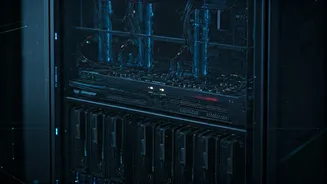










The Heart of the AI Factory
At the core of the global AI boom are sprawling data centers packed with specialized hardware. NVIDIA doesn't just sell individual chips; it provides comprehensive, rack-scale systems like the DGX SuperPOD. These are essentially pre-configured AI supercomputers
in a box, designed for rapid deployment. A single rack can house dozens of powerful GPUs, consuming immense amounts of power—often over 100kW per rack, a huge leap from traditional servers. This intense power density generates an enormous amount of heat, making cooling the single most critical operational challenge. Consequently, the 'backup plan' for these systems isn't just about power; it's about sophisticated thermal management, often involving direct liquid cooling, to prevent catastrophic overheating and costly downtime.
When the Failsafe Fails
Recent reports indicate that NVIDIA's latest generation of AI hardware, the Blackwell platform, has encountered significant issues during customer testing. Specifically, server racks equipped with up to 72 Blackwell chips have reportedly struggled with overheating. These aren't minor glitches; they are fundamental problems with heat management in the densely packed racks that form the building blocks of AI factories. Some reports from early 2026 noted that H200 clusters, a predecessor to Blackwell, experienced significant unplanned downtime due to overheating, costing customers millions in lost compute revenue. Similar issues appear to be plaguing the Blackwell rollout, with customers like Microsoft, Google, and Meta reportedly cutting back initial orders due to these technical problems. The failure occurs when these systems are put under sustained, real-world workloads—the very definition of a customer test—revealing a gap between benchmark performance and operational reliability.
The Challenge of Liquid Cooling
To combat the immense heat from its chips, NVIDIA has heavily invested in direct-to-chip liquid cooling. This technology circulates a fluid through 'cold plates' that sit directly on the processors, pulling heat away far more efficiently than air. The company has even engineered systems to work with coolant as hot as 45°C, reducing the need for energy-intensive water chillers. However, deploying liquid cooling at a massive scale introduces new complexities. It creates a tightly coupled system of pipes and controls, where a failure in the cooling loop can bring down the entire rack. Reports suggest that despite multiple design changes requested by NVIDIA, suppliers have struggled to completely solve the overheating issues in the new Blackwell racks. This highlights a critical vulnerability: as chips get more powerful, the systems designed to keep them from melting down become a potential single point of failure.
Ripple Effects for Customers and the Industry
For companies that have staked their AI ambitions on NVIDIA's roadmap, these failures are a major headache. Delays and performance issues with Blackwell racks could push back the launch of new AI services and impact revenue. Some customers have reportedly been forced to reduce their initial orders or wait for an improved version of the hardware. These reliability concerns create an opening for competitors like AMD and Intel, who are eager to capture a piece of the lucrative AI chip market. While NVIDIA has downplayed the issues as normal 'engineering iterations', the situation underscores a broader industry challenge. The relentless push for more powerful computation is running up against the physical limits of power and thermal management. The failure of a backup system, whether for power or cooling, is a reminder that the foundation of the AI revolution is only as strong as its physical infrastructure.