







Successfully nudging a dangerous asteroid away from Earth might be more complex than just hitting it hard. A new study reveals that for the lumpy, uneven asteroids that populate our solar system, where you hit them matters immensely.
Why Not All Asteroids Are Spheres
When we think of asteroids,
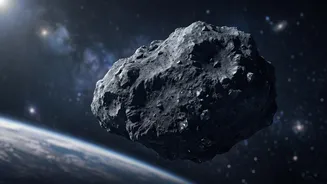
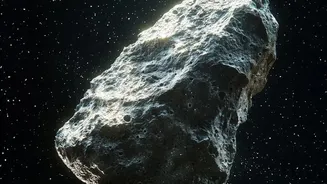
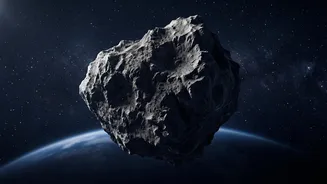
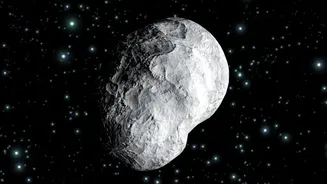
we often picture simple, roundish rocks tumbling through space. The reality is far more interesting and complex. Most asteroids aren't perfect spheres but are instead lumpy, irregular objects. Many are classified as 'rubble piles', loose collections of rock and dust held together by weak gravity. Others are even more peculiar, such as 'contact binaries', which are two separate asteroids that have gently drifted together and are now touching, creating a shape resembling a snowman or a peanut. These odd shapes have long been a challenge for scientists planning planetary defense, as most early models simplified the problem by assuming asteroids were spherical. New research is finally tackling this complexity head-on.
A Fivefold Difference in Deflection
A recent study from researchers at Sandia National Laboratories highlights just how critical an asteroid's shape is. Using advanced computer simulations that are over 1,600 times faster than previous models, they tested how an irregular asteroid would react to a blast of energy, such as from a nearby nuclear detonation. The method involves heating one side of the asteroid with X-rays, causing surface material to vaporise and shoot off, creating a push that nudges the asteroid. The results were startling. For one simulated lumpy asteroid, hitting it from one angle produced a change in velocity that was nearly five times greater than hitting it from another angle. In another simulation, the asteroid's rotation, or spin, varied by a factor of 17 depending on where the energy was directed. This proves that aim is everything.
Building on DART's Real-World Test
This new research doesn't exist in a vacuum. It builds upon the groundbreaking success of NASA's Double Asteroid Redirection Test (DART) mission in 2022. In that mission, a spacecraft was deliberately crashed into Dimorphos, the small moonlet of the asteroid Didymos. The impact successfully shortened Dimorphos's orbit by 33 minutes, more than anticipated. This was partly because the impact ejected tons of rock and debris, providing an extra push. DART targeted a binary system, but Dimorphos itself was a relatively simple target. The new simulations explore what would happen with more complex shapes like Golevka and Itokawa, two well-mapped irregular asteroids, demonstrating that a 'one-size-fitsall' approach won't work.
The Complicated Physics of a Nudge
Think of it like a game of celestial billiards. Hitting a perfectly round, solid ball is predictable. But what if the ball were lumpy, oblong, or made of loosely packed sand? The outcome becomes much harder to calculate. When you hit an irregular asteroid, factors like its surface topography—ridges, craters, and boulders—all play a role. An impact on a sloped surface might send debris flying in a direction that provides less of a push forward. Hitting a 'rubble pile' might absorb more of the impact energy, like punching a beanbag. The goal of planetary defense is a controlled push, not shattering the asteroid into multiple pieces that could still pose a threat to Earth. This makes understanding the target's physical properties absolutely essential.
Smarter Strategies for Planetary Defense
The key takeaway from this research is that future planetary defense missions will need to be much more sophisticated. Instead of just launching an impactor towards the center of an asteroid, we will likely need detailed reconnaissance first. Missions like Europe's Hera, which is currently en route to the Didymos system to study the aftermath of the DART impact, are crucial. Hera will map the crater, measure the asteroid's mass, and determine its composition, providing a 'crash scene investigation' that will help refine our models. For any future threat, knowing the asteroid's exact shape, spin, and whether it's solid rock or a loose pile of rubble will allow scientists to pick the optimal impact point to ensure a successful deflection.