


The Sun's Chemical Puzzle
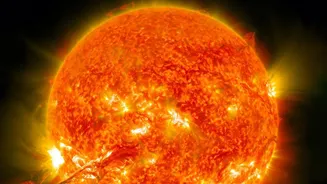
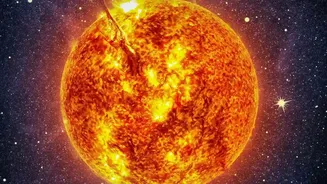
For years, astronomers have been puzzled by certain aspects of the sun's composition and structure. Standard models of how stars evolve can't quite account for everything we see. For instance, there are subtle discrepancies between the observed internal
structure and what stellar models predict. One of the most significant puzzles is the sun's surprisingly low amount of the element lithium on its surface. Lithium is an element that is easily destroyed at the high temperatures inside a star, so its abundance can tell a story about a star's history. These long-standing anomalies have led scientists to wonder if a major event in the sun's early life could be the missing piece of the puzzle.
A Violent, Chaotic Youth
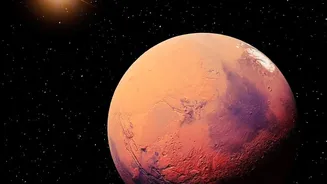
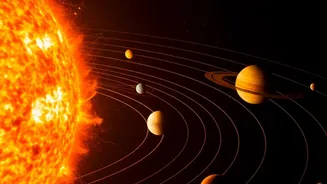
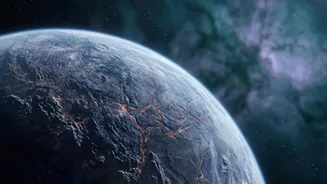
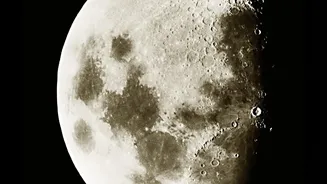
The early solar system, billions of years ago, was not the relatively orderly place we know today. It was a chaotic shooting gallery of dust, gas, and forming planets, known as protoplanets. Gravitational interactions would have been intense, sending worlds crashing into each other or flinging them on new, unstable orbits. It’s widely believed that a Mars-sized object named Theia collided with early Earth to form our moon. In such a turbulent environment, it's plausible that one or more planets could have been sent on a collision course with the young, developing sun. This idea is bolstered by the fact that super-Earths—planets larger than Earth but smaller than Neptune—are incredibly common in other star systems, yet our solar system lacks one. Perhaps ours met a fiery end.
The Planet-Eating Hypothesis
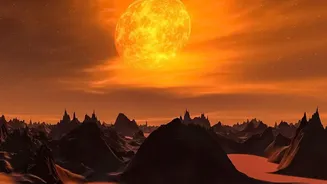
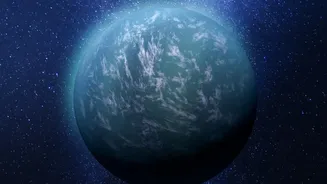
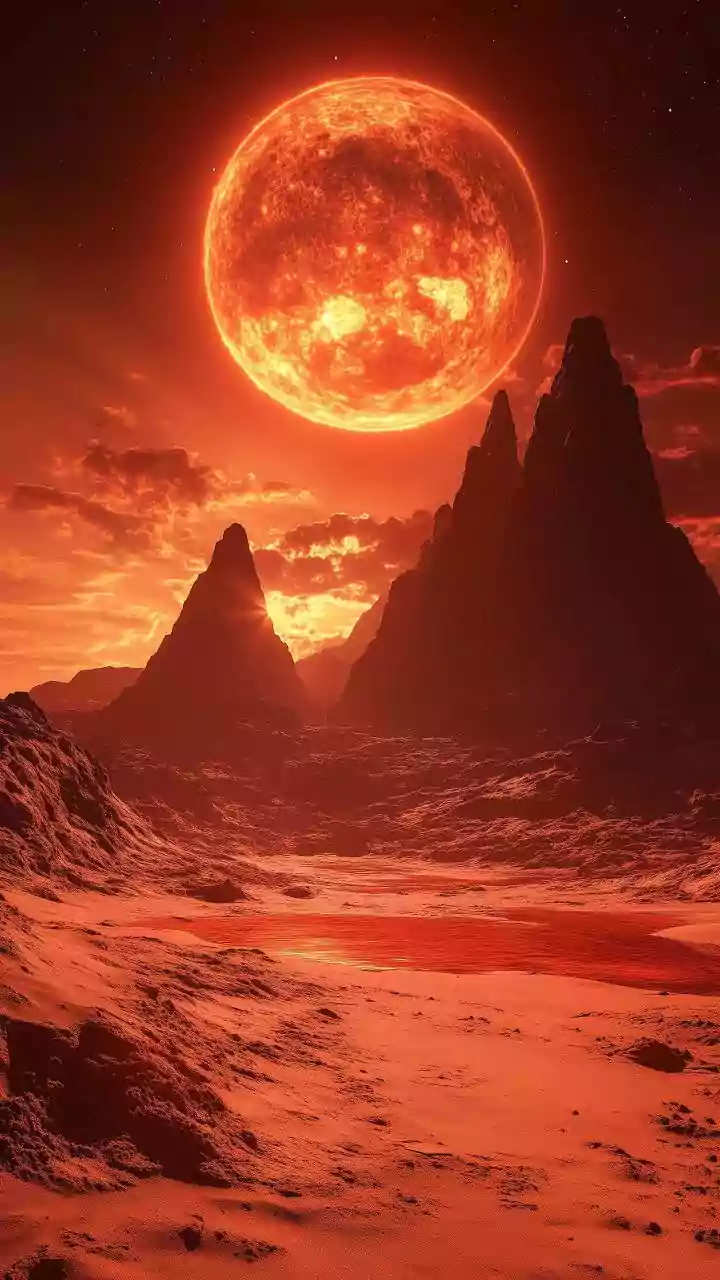
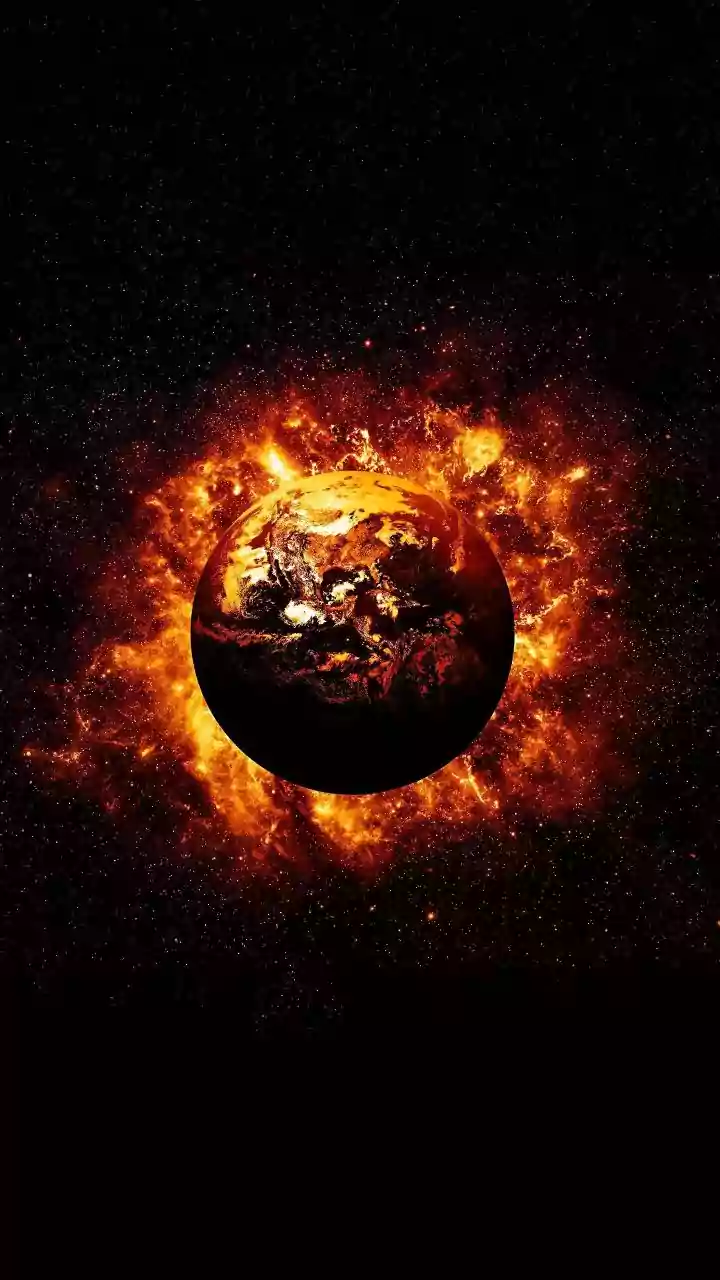
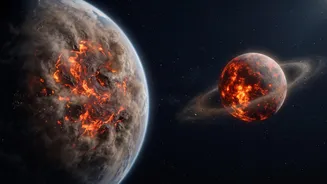
A recent study published in the journal Monthly Notices of the Royal Astronomical Society puts forward a compelling theory: the young sun engulfed a super-Earth. Researchers from Ege University in Turkey ran sophisticated computer models to see if such an event could explain the sun's strange characteristics. Their calculations showed that the ingestion of a planet between five to ten times the mass of Earth could neatly resolve the discrepancies. According to the models, a planet of this size could penetrate the sun's turbulent outer layers and deposit its material deep inside. Since planets are made of different, heavier materials (what astronomers call 'metals') than the primordial gas of the sun, this would have permanently altered the star's chemical makeup. This added material could change the internal structure and explain the mysteriously low levels of surface lithium.
Searching for the Evidence
While this is a powerful hypothesis, it is based on modeling and is not yet proven. Scientists cannot simply look inside the sun to find planetary remains. Instead, they must search for indirect evidence. One key method is helioseismology, the study of the sun's interior by observing vibrations and sound waves on its surface. If a massive planet was absorbed, it should have subtly altered the way sound waves travel through the sun's core, leaving a faint but detectable signature. Another approach is to compare the sun's chemical composition with that of its stellar 'twins'—stars born from the same initial cloud of gas and dust. Studies of binary star systems, where two stars share the same origin, have shown that differences in their composition can sometimes be explained by one star having engulfed a planet. These observations lend weight to the idea that stellar cannibalism is a real and significant process in the galaxy.
What This Means for Our Solar System
Confirming that our sun devoured a planet would reshape our understanding of how planetary systems form and evolve. It would suggest that the early history of our own cosmic neighbourhood was far more violent and unpredictable than we imagined. It provides a neat explanation for why super-Earths, a common type of planet elsewhere, are absent from our solar system—ours may have been the sun's ancient meal. This research highlights that a star is not just a static ball of fire, but a dynamic body whose history is intertwined with the planets that orbit it. The sun, it seems, is not just a passive observer but an active participant in the story of our solar system, with a secret history written deep within its fiery heart.