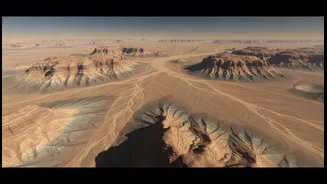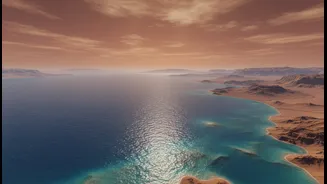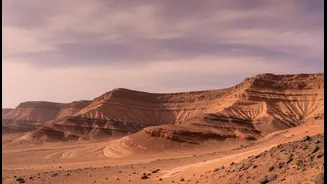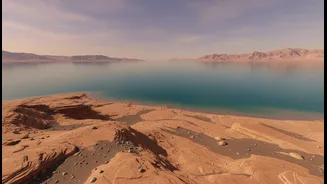




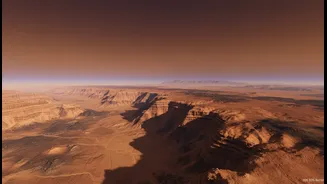


A New Vision of a Blue Mars
The idea of a watery Mars isn't new, but the debate has long been whether the water came from catastrophic floods or a stable, long-lasting ocean. Recent studies are tipping the scales dramatically toward the latter. Scientists now propose that a primordial
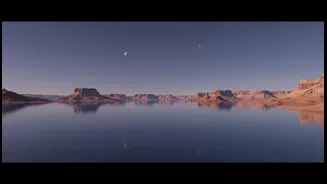
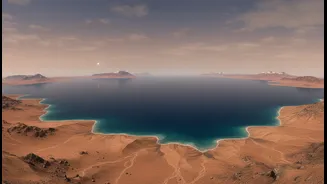
ocean, nicknamed Oceanus Borealis, filled the vast lowlands of the Martian northern hemisphere around 3.5 billion years ago. This body of water could have covered roughly 36% of the planet's surface, holding a volume of water comparable to a significant portion of Earth's oceans. This wasn't just a fleeting puddle; the evidence points to a stable feature of the Martian landscape that existed for a prolonged period, long enough to shape the planet's geology in profound ways.
Reading the Martian 'Bathtub Ring'
So, how can scientists be so confident about an ocean that vanished billions of years ago? The clues are written in the rocks and the very shape of the land. For years, researchers were puzzled by what looked like ancient shorelines at inconsistent elevations. But recent approaches have looked for a more durable feature, something akin to Earth's continental shelves. Using advanced topographic maps and ground-penetrating radar from rovers like China's Zhurong, scientists have identified thick sedimentary deposits and landforms that strongly resemble river deltas and submarine channels. One study identified over 6,500 kilometers of fluvial ridges that trace the edge of this ancient sea in a region called Aeolis Dorsa. These features are like a giant 'bathtub ring', a geological high-water mark left behind by a massive, stable body of water.
A Dynamic, Water-Filled World
The existence of such a massive ocean implies that ancient Mars was a far more dynamic and Earth-like world than it is today. To support liquid water on the surface, the planet would have needed a much thicker, warmer atmosphere. Evidence suggests a global water cycle, complete with precipitation, runoff into rivers that carved valleys, and the accumulation of water in this northern ocean. Researchers believe volcanoes may have played a key role, spewing gases into the atmosphere that created a greenhouse effect, warming the planet enough for water to remain liquid. This wasn't a static pool; evidence of significant sea-level rise and thick layers of sediment suggest a dynamic environment where tides may have ebbed and flowed, and rivers constantly delivered nutrients from the highlands.
The Ultimate Question: Was There Life?
Whenever we find evidence of long-lasting liquid water, the next question is inevitable: could life have existed there? On Earth, life is thought to have originated in our oceans. A similar body of water on Mars, stable for millions of years and fed by nutrient-carrying rivers, would have been the perfect incubator. The sedimentary deposits along these ancient shorelines are now prime targets in the search for biosignatures, the chemical fingerprints of past life. Deltas, in particular, are excellent at preserving organic matter. While we haven't found definitive proof of Martian life, the confirmation of a long-lived ocean dramatically increases the potential habitability of ancient Mars. It tells scientists exactly where to look next, transforming the search from a hopeful guess into a targeted investigation.